博文
一张 1940 年普查表,看见地球物理学家的小时候
||
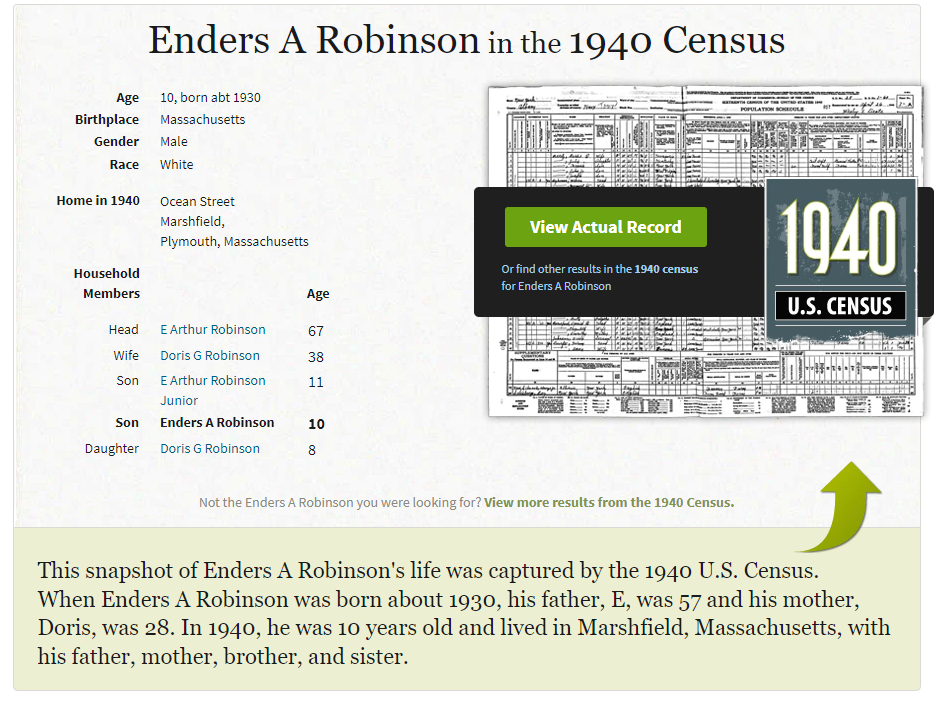
看着这张 1940 年的普查表,字里行间都浸着旧时光的实诚 —— 十岁的恩德斯・罗宾逊(Enders A. Robinson),就这么被一行行数字钉在了马萨诸塞的 Ocean Street 上,连父亲 67 岁的年纪、妹妹 8 岁的个头都没漏掉。美国这档案像是把日子腌进了纸里,几十年后扒拉出来,还能闻见当年的烟火气。
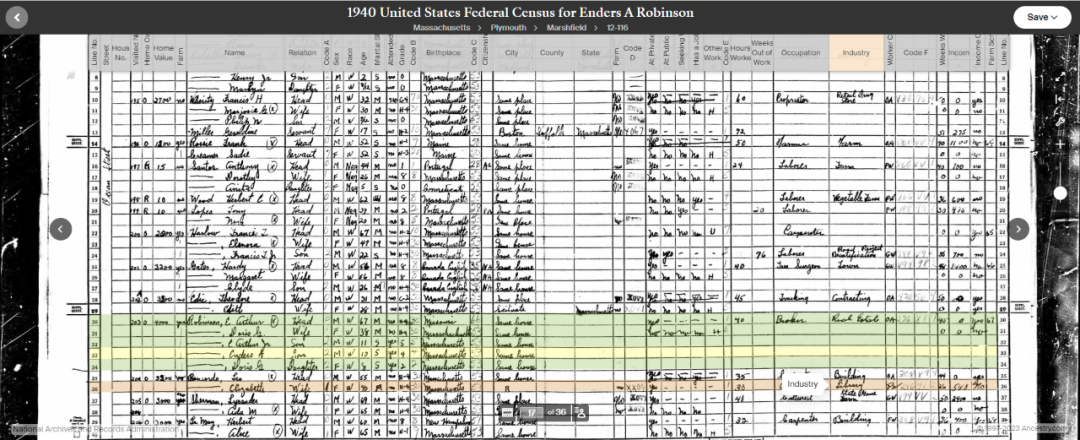
这人后来成了地球物理界的大人物,把物探数据从模拟捣鼓成数字,在 MIT 攒起个小组就掀了场革命,书堆得比他当年住的房子还高,奖拿得能压弯门框。可再厉害的人,在这张表上也只是个叫 “Enders A Robinson” 的十岁男孩,和哥哥妹妹挤在同一个屋檐下,像颗刚冒芽的种子,谁也猜不着后来能长那么高。
2022年他走了,92 岁的人生收了尾,可这张纸还在这儿 —— 像把他十岁那年的影子剪下来,夹在时光的本子里,等着有人翻到这一页,突然看见:哦,原来大师也有过这么小的年纪。
Enders A. Robinson(1930-2022) is an American Geophysicist and one of the scientists responsible for the transition from analog to digital data processing in geophysics. Enders is the Maurice Ewing and J. L. Worzel Professor of Geophysics at Columbia University in New York City. Robinson gained international prominence in the early 1950’s when he was the founder of the Geophysical Analysis Group (GAG) at MIT. GAG research lead to the digital revolution in geophysics a decade later. Robinson published more than 25 books on digital signal analysis, seismic data processing, and wavelet estimation. Robinson helped found Digicon in 1965; there he developed the first commercial programs for academic positions, including the McMan Distinguished Professor of Geophysics at the University of Tulsa. Robinson is the highest honored scientist in the field of geophysics, SEG’s Reginald Fessenden award 1969, the EAEG’s CSch award 1969, and the IEEE’s DGFP award 1984. He was elected to the National Academy of Engineering in 1988. He is an honorary member of SEG and EAEG. He has written more than 25 books on digital signal analysis, seismic data processing and wavelet estimation, and published over 60 papers.
https://blog.sciencenet.cn/blog-339326-1518378.html
上一篇:地球物理学家的冷笑话
下一篇:一代棋圣聂卫平辞世