博文
A Faithful Rubik’s Cube Representation of the Oh Point Group
||
Symmetry Made Visible: A Faithful Rubik’s‑Cube Representation of the Oh Point Group
Structure of This Article. This article begins by introducing a faithful Rubik’s‑Cube representation of the Oh point group, then explains the fundamental algorithm (T0) and its edge‑cubie permutation. After that, all 48 elements of the Oh point group are applied to (T0), producing 48 new algorithms and 48 visible cube patterns—one for each symmetry operation. The article concludes by pointing toward the Ih point group, the “cosmic Ferris wheel,” which will be explored in the next chapter.
I constructed a faithful representation of the Oh point group using my Rubik’s‑Cube equations and atomic‑environment calculations. Building on this foundation, I then used the Megaminx to construct a faithful representation of the Ih point group.
The faithful representation of the Oh point group is like a Ferris wheel: it has 48 Rubik’s‑Cube cabins, each one corresponding exactly to one of the 48 elements of the Oh point group. If the Oh point group is the Ferris wheel of the Earth, then the Ih point group is the Ferris wheel of the Universe, because it has 120 Megaminx cabins, each one corresponding exactly to one of the 120 elements of the Ih point group.
Today, let’s use 48 cubes to play with the Oh point group.
If you have 48 Rubik’s Cubes all in the solved state, then by following the 48 algorithms I provide, you can quite literally play the entire Oh point group in the palm of your hand. Learn it, use it, play with it — and play is the highest realm.

The Oh point group contains 48 elements: eight C₃ axes, six C₂ axes parallel to the face diagonals, six C₄ axes, three additional C₂ axes, six S₄ axes, eight S₆ axes, three horizontal mirror planes, six diagonal mirror planes, one inversion center, and the identity — forty‑eight symmetry operations in total. The cube’s highest symmetry is precisely the Oh point group.
Using 48 Rubik’s Cubes to represent the 48 elements of the Oh point group — one cube for each symmetry operation — makes the entire group visible and tangible. You can literally see it and hold it in your hands.


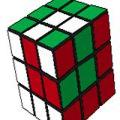
The edge‑cubie permutation triangle in the left figure is produced by the algorithm B2 U R L’ B2 L R’ U B2 = T₀. This triangle is created by applying T₀ once. If you want to eliminate it, you can also use T₀, but you need to apply it two more times.
Next, by acting on T₀ with the 48 point‑group elements of Oh, I obtained 48 new algorithms. Each of these algorithms produces a cube pattern that corresponds one‑to‑one with one of the 48 elements of the Oh point group.
1-e(B2URL’B2LR’UB2)=B2URL’B2LR’UB2


When the point‑group element e acts on the triangle in the left figure, the triangle remains completely unchanged: its position does not move, and the direction of its permutation also stays the same. When I apply the point‑group element e to the algorithm B2 U R L’ B2 L R’ U B2, the resulting algorithm is still exactly the same B2 U R L’ B2 L R’ U B2.
Evidently, applying this algorithm to a solved cube produces the cube pattern shown in the right figure. I label this pattern as the e‑cube.
2-C4[100](B2URL’B2LR’UB2)=B2RDU’B2UD’RB2


The point‑group element C₄[100] rotates the left‑hand triangle onto the R face — that is, a 90° rotation about the X‑axis. When I apply the point‑group operation C₄[100] to the algorithm B² U R L’ B² L R’ U B²), I obtain a new algorithm B² R D U’ B² U D’ R B². Using this new sequence on a solved cube produces the pattern shown on the right. I label this cube as the C₄[100]‑cube.
3-C4[010](B2URL’B2LR’UB2)=D2BRL’D2LR’BD2


The point‑group element C₄[010] rotates the left‑hand triangle onto the B face — that is, a 90° rotation about the Y‑axis, sending it to the B face. When I apply the point‑group operation C₄[010] to the algorithm B² U R L’ B² L R’ U B², I obtain a new algorithm D² B R L’ D² L R’ B D². Using this new algorithm on a solved cube produces the pattern shown on the right. I label this cube as the C₄[010]‑cube.
4-C4[001](B2URL’B2LR’UB2)=R2UFB’R2BF’UR2


The point‑group element C₄[001] rotates the triangle in the left figure by 90° about the Z‑axis, keeping the triangle on the U face. When I apply the point‑group operation C₄[001] to the algorithm B² U R L’ B² L R’ U B², I obtain a new algorithm R² U F B’ R² B F’ U R². Using this new algorithm on a solved cube produces the pattern shown on the right. I label this cube as the C₄[001]‑cube.
5-C4^3[100](B2URL’B2LR’UB2)=B2LUD’B2DU’LB2

The point‑group element C₄³[100] rotates the triangle in the left figure onto the L face — that is, a 270° rotation about the X‑axis, sending it to the L face. When I apply the point‑group operation C₄³[100] to the algorithm B² U R L’ B² L R’ U B², I obtain a new algorithm: B² L U D’ B² D U’ L B². Using this new algorithm on a solved cube produces the pattern shown on the right. I label this cube as the C₄³[100]‑cube.
6-C4^3[010](B2URL’B2LR’UB2)=U2FRL’U2LR’FU2


The point‑group element C₄³[010] rotates the triangle in the left figure onto the F face — that is, a 270° rotation about the Y‑axis, sending it to the F face. When I apply the element C₄³[010] to the algorithm B² U R L’ B² L R’ U B², I obtain a new algorithm: U² F R L’ U² L R’ F U². Using this new algorithm on a solved cube produces the pattern shown on the right. I label this cube as the C₄³[010]‑cube.
7-C4^3[001](B2URL’B2LR’UB2)=L2UBF’L2FB’UL2

The point‑group element C₄³[001] rotates the triangle in the left figure by 270° about the Z‑axis, keeping the triangle on the U face. When I apply the element C₄³[001] to the algorithm B² U R L’ B² L R’ U B², I obtain a new algorithm: L² U B F’ L² F B’ U L². Using this new algorithm on a solved cube produces the pattern shown on the right. I label this cube as the C₄³[001]‑cube.
8-C4^2[100](B2URL’B2LR’UB2)=B2DLR’B2RL’DB2


The point‑group element C₄²[100] rotates the triangle in the left figure onto the D face — that is, a 180° rotation about the X‑axis, sending it to the D face. When I apply the point‑group element C₄²[100] to the algorithm B² U R L’ B² L R’ U B², I obtain a new algorithm: B² D L R’ B² R L’ D B². Using this new algorithm on a solved cube produces the pattern shown on the right. I label this cube as the C₄²[100]‑cube. It is worth noting that C₄²[100] = C₂[100], the 2‑fold axis of the Oh point group.
9-C4^2[010](B2URL’B2LR’UB2)=F2DRL’F2LR’DF2


The point‑group element C₄²[010] rotates the triangle in the left figure onto the D face — that is, a 180° rotation about the Y‑axis, sending it to the D face. When I apply the element C₄²[010] to the algorithm B² U R L’ B² L R’ U B², I obtain a new algorithm: F² D R L’ F² L R’ D F². Using this new algorithm on a solved cube produces the pattern shown on the right. I label this cube as the C₄²[010]‑cube. It is worth noting that C₄²[010] = C₂[010], one of the 2‑fold axes of the Oh point group.
10-C4^2[001](B2URL’B2LR’UB2)=F2ULR’F2RL’UF2


The point‑group element C₄²[001] rotates the triangle in the left figure by 180° about the Z‑axis, keeping the triangle on the U face. When I apply the point‑group element C₄²[001] to the algorithm B² U R L’ B² L R’ U B², I obtain a new algorithm: F² U L R’ F² R L’ U F². Using this new algorithm on a solved cube produces the pattern shown on the right. I label this cube as the C₄²[001]‑cube. It is worth noting that C₄²[001] = C₂[001], one of the 2‑fold axes of the Oh point group.
11-C3[111](B2URL’B2LR’UB2)=D2RFB’D2BF’RD2


The point‑group element C₃[111] rotates the triangle in the left figure onto the R face — that is, a 120° rotation about the [111] axis, sending it to the R face. When I apply the point‑group element C₃[111] to the algorithm B² U R L’ B² L R’ U B², I obtain a new algorithm: F² D R L’ F² L R’ D F². Using this new algorithm on a solved cube produces the pattern shown on the right. I label this cube as the C₃[111]‑cube.
12-C3[11-1](B2URL’B2LR’UB2)=L2BDU’L2UD’BL2


The point‑group element C₃[11‑1] rotates the triangle in the left figure onto the B face — that is, a 120° rotation about the [11‑1] axis, sending it to the B face. When I apply the point‑group element C₃[11‑1] to the algorithm B² U R L’ B² L R’ U B², I obtain a new algorithm: L² B D U’ L² U D’ B L². Using this new algorithm on a solved cube produces the pattern shown on the right. I label this cube as the C₃[11‑1]‑cube.
13-C3[-111](B2URL’B2LR’UB2)=R2BUD’R2DU’BR2


The point‑group element C₃[‑111] rotates the triangle in the left figure onto the B face — that is, a 120° rotation about the [‑111] axis, sending it to the B face. When I apply the point‑group element C₃[‑111] to the algorithm B² U R L’ B² L R’ U B², I obtain a new algorithm: R² B U D’ R² D U’ B R². Using this new algorithm on a solved cube produces the pattern shown on the right. I label this cube as the C₃[‑111]‑cube.
14-C3[1-11](B2URL’B2LR’UB2)=R2FDU’R2UD’FR2

The point‑group element C₃[1‑11] rotates the triangle in the left figure onto the F face — that is, a 120° rotation about the [1‑11] axis, sending it to the F face. When I apply the point‑group element C₃[1‑11] to the algorithm B² U R L’ B² L R’ U B², I obtain a new algorithm: R² F D U’ R² U D’ F R². Using this new algorithm on a solved cube produces the pattern shown on the right. I label this cube as the C₃[1‑11]‑cube.
15-C3^2[111](B2URL’B2LR’UB2)=L2FUD’L2DU’FL2


The point‑group element C₃²[111] rotates the triangle in the left figure onto the F face — that is, a 240° rotation about the [111] axis, sending it to the F face. When I apply the point‑group element C₃²[111] to the algorithm B² U R L’ B² L R’ U B², I obtain a new algorithm: L² F U D’ L² D U’ F L². Using this new algorithm on a solved cube produces the pattern shown on the right. I label this cube as the C₃²[111]‑cube.
16-C3^2[11-1](B2URL’B2LR’UB2)=U2LFB’U2BF’LU2


The point‑group element C₃²[11‑1] rotates the triangle in the left figure onto the L face — that is, a 240° rotation about the [11‑1] axis, sending it to the L face. When I apply the point‑group element C₃²[11‑1] to the algorithm B² U R L’ B² L R’ U B², I obtain a new algorithm: U² L F B’ U² B F’ L U². Using this new algorithm on a solved cube produces the pattern shown on the right. I label this cube as the C₃²[11‑1]‑cube.
17-C3^2[-111](B2URL’B2LR’UB2)=U2RBF’U2FB’RU2


The point‑group element C₃²[‑111] rotates the triangle in the left figure onto the R face — that is, a 240° rotation about the [‑111] axis, sending it to the R face. When I apply the point‑group element C₃²[‑111] to the algorithm B² U R L’ B² L R’ U B², I obtain a new algorithm: U² R B F’ U² F B’ R U². Using this new algorithm on a solved cube produces the pattern shown on the right. I label this cube as the C₃²[‑111]‑cube.
18-C3^2[1-11](B2URL’B2LR’UB2)=D2LBF’D2FB’LD2


The point‑group element C₃²[1‑11] rotates the triangle in the left figure onto the L face — that is, a 240° rotation about the [1‑11] axis, sending it to the L face. When I apply the point‑group element C₃²[1‑11] to the algorithm B² U R L’ B² L R’ U B², I obtain a new algorithm: D² L B F’ D² F B’ L D². Using this new algorithm on a solved cube produces the pattern shown on the right. I label this cube as the C₃²[1‑11]‑cube.
19-C2[110](B2URL’B2LR’UB2)=L2DFB’L2BF’DL2


The point‑group element C₂[110] rotates the triangle in the left figure onto the D face — that is, a 180° rotation about the [110] axis, sending it to the D face. When I apply the point‑group element C₂[110] to the algorithm B² U R L’ B² L R’ U B², I obtain a new algorithm: L² D F B’ L² B F’ D L². Using this new algorithm on a solved cube produces the pattern shown on the right. I label this cube as the C₂[110]‑cube.
20-C2[011](B2URL’B2LR’UB2)=F2RUD’F2DU’RF2


The point‑group element C₂[011] rotates the triangle in the left figure onto the R face — that is, a 180° rotation about the [011] axis, sending it to the R face. When I apply the point‑group element C₂[011] to the algorithm B² U R L’ B² L R’ U B², I obtain a new algorithm: F² R U D’ F² D U’ R F². Using this new algorithm on a solved cube produces the pattern shown on the right. I label this cube as the C₂[011]‑cube.
21-C2[101](B2URL’B2LR’UB2)=D2FLR’D2RL’FD2


The point‑group element C₂[101] rotates the triangle in the left figure onto the F face — that is, a 180° rotation about the [101] axis, sending it to the F face. When I apply the point‑group element C₂[101] to the algorithm B² U R L’ B² L R’ U B², I obtain a new algorithm: D² F L R’ D² R L’ F D². Using this new algorithm on a solved cube produces the pattern shown on the right. I label this cube as the C₂[101]‑cube.
22-C2[01-1](B2URL’B2LR’UB2)=F2LDU’F2UD’LF2

The point‑group element C₂[01‑1] rotates the triangle in the left figure onto the L face — that is, a 180° rotation about the [01‑1] axis, sending it to the L face. When I apply the point‑group element C₂[01‑1] to the algorithm B² U R L’ B² L R’ U B², I obtain a new algorithm: F² L D U’ F² U D’ L F². Using this new algorithm on a solved cube produces the pattern shown on the right. I label this cube as the C₂[01‑1]‑cube.
23-C2[10-1](B2URL’B2LR’UB2)=U2BLR’U2RL’BU2


The point‑group element C₂[10‑1] rotates the triangle in the left figure onto the B face — that is, a 180° rotation about the [10‑1] axis, sending it to the B face. When I apply the point‑group element C₂[10‑1] to the algorithm B² U R L’ B² L R’ U B², I obtain a new algorithm: U² B L R’ U² R L’ B U². Using this new algorithm on a solved cube produces the pattern shown on the right. I label this cube as the C₂[10‑1]‑cube.
24-C2[1-10](B2URL’B2LR’UB2)=R2DBF’R2FB’DR2


The point‑group element C₂[1‑10] rotates the triangle in the left figure onto the D face — that is, a 180° rotation about the [1‑10] axis, sending it to the D face. When I apply the point‑group element C₂[1‑10] to the algorithm B² U R L’ B² L R’ U B², I obtain a new algorithm: R² D B F’ R² F B’ D R². Using this new algorithm on a solved cube produces the pattern shown on the right. I label this cube as the C₂[1‑10]‑cube.
It is important to emphasize that all of the operations above are pure rotations. Both before and after each operation, the three‑edge triangle permutation remains a clockwise cycle. All of the following operations, however, are non‑pure rotational operations. After applying these non‑pure rotational elements of the Oh point group, the edge‑triangle permutation becomes a counterclockwise cycle.
25-i(B2URL’B2LR’UB2)=F2D’L’RF2R’LD’F2


The point‑group element i inverts the triangle in the left figure onto the D face. When I apply the point‑group element i to the algorithm B² U R L’ B² L R’ U B², I obtain a new algorithm: F² D’ L’ R F² R’ L D’ F². Using this new algorithm on a solved cube produces the pattern shown on the right. I label this cube as the i‑cube.
26-S4[100](B2URL’B2LR’UB2)=F2R’D’UF2U’DR’F2

The point‑group element S₄[100] moves the triangle in the left figure onto the R face. It first rotates the triangle 90° about the [100] axis, and then applies the mirror reflection m(100), sending the triangle to the R face. When I apply the point‑group element S₄[100] to the algorithm B² U R L’ B² L R’ U B², I obtain a new algorithm: F² R’ D’ U F² U’ D R’ F². Using this new algorithm on a solved cube produces the pattern shown on the right. I label this cube as the S₄[100]‑cube.
27-S4[010](B2URL’B2LR’UB2)=D2B’L’RD2R’LB’D2


The point‑group element S₄[010] moves the triangle in the left figure onto the B face. It first rotates the triangle 90° about the [010] axis, and then applies the mirror reflection m(010), sending the triangle to the B face. When I apply the point‑group element S₄[010] to the algorithm B² U R L’ B² L R’ U B², I obtain a new algorithm: D² B’ L’ R D² R’ L B’ D². Using this new algorithm on a solved cube produces the pattern shown on the right. I label this cube as the S₄[010]‑cube.
28-S4[001](B2URL’B2LR’UB2)=R2D’F’BR2B’FD’R2


The point‑group element S₄[001] moves the triangle in the left figure onto the D face. It first rotates the triangle 90° about the [001] axis, and then applies the mirror reflection m(001), sending the triangle to the D face. When I apply the point‑group element S₄[001] to the algorithm B² U R L’ B² L R’ U B², I obtain a new algorithm: R² D’ F’ B R² B’ F D’ R². Using this new algorithm on a solved cube produces the pattern shown on the right. I label this cube as the S₄[001]‑cube.
29-S4^3[100](B2URL’B2LR’UB2)=F2L’U’DF2D’UL’F2

The point‑group element S₄³[100] moves the triangle in the left figure onto the L face. It first rotates the triangle 270° about the [100] axis, and then applies the mirror reflection m(100), sending the triangle to the L face. When I apply the point‑group element S₄³[100] to the algorithm B² U R L’ B² L R’ U B², I obtain a new algorithm: F² L’ U’ D F² D’ U L’ F². Using this new algorithm on a solved cube produces the pattern shown on the right. I label this cube as the S₄³[100]‑cube.
30-S4^3[010](B2URL’B2LR’UB2)=U2F’L’RU2R’LF’U2


The point‑group element S₄³[010] moves the triangle in the left figure onto the F face. It first rotates the triangle 270° about the [010] axis, and then applies the mirror reflection m(010), sending the triangle to the F face. When I apply the point‑group element S₄³[010] to the algorithm B² U R L’ B² L R’ U B², I obtain a new algorithm: U² F’ L’ R U² R’ L F’ U². Using this new algorithm on a solved cube produces the pattern shown on the right. I label this cube as the S₄³[010]‑cube.
31-S4^3[001](B2URL’B2LR’UB2)=L2D’B’FL2F’BD’L2


The point‑group element S₄³[001] moves the triangle in the left figure onto the D face. It first rotates the triangle 270° about the [001] axis, and then applies the mirror reflection m(001), sending the triangle to the D face. When I apply the point‑group element S₄³[001] to the algorithm B² U R L’ B² L R’ U B², I obtain a new algorithm: L² D’ B’ F L² F’ B D’ L².
32-S6[111](B2URL’B2LR’UB2)=R2B’D’UR2U’DB’R2


The point‑group element S₆[111] moves the triangle in the left figure onto the B face. It first rotates the triangle 60° about the [111] axis, and then applies the mirror reflection m(111), sending the triangle to the B face. When I apply the point‑group element S₆[111] to the algorithm B² U R L’ B² L R’ U B², I obtain a new algorithm: R² B’ D’ U R² U’ D B’ R². Using this new algorithm on a solved cube produces the pattern shown on the right. I label this cube as the S₆[111]‑cube.
33-S6[11-1](B2URL’B2LR’UB2)=D2R’B’FD2F’BR’D2


The point‑group element S₆[11‑1] moves the triangle in the left figure onto the R face. It first rotates the triangle 60° about the [11‑1] axis, and then applies the mirror reflection m(11‑1), sending the triangle to the R face. When I apply the point‑group element S₆[11‑1] to the algorithm B² U R L’ B² L R’ U B², I obtain a new algorithm: D² R’ B’ F D² F’ B R’ D². Using this new algorithm on a solved cube produces the pattern shown on the right. I label this cube as the S₆[11‑1]‑cube.
34-S6[-111](B2URL’B2LR’UB2)=D2L’F’BD2B’FL’D2


The point‑group element S₆[–111] moves the triangle in the left figure onto the L face. It first rotates the triangle 60° about the [–111] axis, and then applies the mirror reflection m(–111), sending the triangle to the L face. When I apply the point‑group element S₆[–111] to the algorithm B² U R L’ B² L R’ U B², I obtain a new algorithm: D² L’ F’ B D² B’ F L’ D². Using this new algorithm on a solved cube produces the pattern shown on the right. I label this cube as the S₆[–111]‑cube.
35-S6[1-11](B2URL’B2LR’UB2)=U2R’F’BU2B’FR’U2


The point‑group element S₆[1‑11] moves the triangle in the left figure onto the L face. It first rotates the triangle 60° about the [1‑11] axis, and then applies the mirror reflection m(1‑11), sending the triangle to the L face. When I apply the point‑group element S₆[1‑11] to the algorithm B² U R L’ B² L R’ U B², I obtain a new algorithm: U² R’ F’ B U² B’ F R’ U². Using this new algorithm on a solved cube produces the pattern shown on the right. I label this cube as the S₆[1‑11]‑cube.
36-S6^5[111](B2URL’B2LR’UB2)=U2L’B’FU2F’BL’U2


The point‑group element S₆⁵[111] moves the triangle in the left figure onto the L face. It first rotates the triangle 300° about the [111] axis, and then applies the mirror reflection m(111), sending the triangle to the L face. When I apply the point‑group element S₆⁵[111] to the algorithm B² U R L’ B² L R’ U B², I obtain a new algorithm: U² L’ B’ F U² F’ B L’ U². Using this new algorithm on a solved cube produces the pattern shown on the right. I label this cube as the S₆⁵[111]‑cube.
37-S6^5[11-1](B2URL’B2LR’UB2)=R2F’U’DR2D’UF’R2


The point‑group element S₆⁵[11‑1] moves the triangle in the left figure onto the F face. It first rotates the triangle 300° about the [11‑1] axis, and then applies the mirror reflection m(11‑1), sending the triangle to the F face. When I apply the point‑group element S₆⁵[11‑1] to the algorithm B² U R L’ B² L R’ U B², I obtain a new algorithm: R² F’ U’ D R² D’ U F’ R². Using this new algorithm on a solved cube produces the pattern shown on the right. I label this cube as the S₆⁵[11‑1]‑cube.
38-S6^5[-111](B2URL’B2LR’UB2)=L2F’D’UL2U’DF’L2


The point‑group element S₆⁵[–111] moves the triangle in the left figure onto the F face. It first rotates the triangle 300° about the [–111] axis, and then applies the mirror reflection m(–111), sending the triangle to the F face. When I apply the point‑group element S₆⁵[–111] to the algorithm B² U R L’ B² L R’ U B², I obtain a new algorithm: L² F’ D’ U L² U’ D F’ L². Using this new algorithm on a solved cube produces the pattern shown on the right. I label this cube as the S₆⁵[–111]‑cube.
39-S6^5[1-11](B2URL’B2LR’UB2)=L2B’U’DL2D’UB’L2


The point‑group element S₆⁵[1‑11] moves the triangle in the left figure onto the B face. It first rotates the triangle 300° about the [1‑11] axis, and then applies the mirror reflection m(1‑11), sending the triangle to the B face. When I apply the point‑group element S₆⁵[1‑11] to the algorithm B² U R L’ B² L R’ U B², I obtain a new algorithm: L² B’ U’ D L² D’ U B’ L². Using this new algorithm on a solved cube produces the pattern shown on the right. I label this cube as the S₆⁵[1‑11]‑cube.
40-Qh(100)(B2URL’B2LR’UB2)=F2U’R’LF2L’RU’F2


The point‑group element Qₕ(100) reflects the triangle on the U face across the (100) mirror plane. After the reflection, the triangle remains on the U face, but its orientation changes: its edge‑triangle permutation switches from clockwise to counterclockwise, as shown in the right figure. When I apply the point‑group element Qₕ(100) to the algorithm B² U R L’ B² L R’ U B², I obtain a new algorithm: F² U’ R’ L F² L’ R U’ F². Using this new algorithm on a solved cube produces the pattern shown on the right. I label this cube as the m(100)‑cube. Note that Qₕ(100) = m(100).
41-Qh(010)(B2URL’B2LR’UB2)=B2U’L’RB2R’LU’B2


The point‑group element Qₕ(010) reflects the triangle on the U face across the (010) mirror plane. After the reflection, the triangle remains on the U face, and its orientation does not change, but its edge‑triangle permutation switches from clockwise to counterclockwise, as shown in the right figure. When I apply the point‑group element Qₕ(010) to the algorithm B² U R L’ B² L R’ U B², I obtain a new algorithm: B² U’ L’ R B² R’ L U’ B². Using this new algorithm on a solved cube produces the pattern shown on the right. I label this cube as the m(010)‑cube. Note that Qₕ(010) = m(010).
42-Qh(001)(B2URL’B2LR’UB2)=B2D’R’LB2L’RD’B2

The point‑group element Qₕ(001) reflects the triangle on the U face across the (001) mirror plane. After the reflection, the triangle is moved from the U face to the D face, and its edge‑triangle permutation switches from clockwise to counterclockwise, as shown in the right figure. When I apply the point‑group element Qₕ(001) to the algorithm B² U R L’ B² L R’ U B², I obtain a new algorithm: B² D’ R’ L B² L’ R D’ B². Using this new algorithm on a solved cube produces the pattern shown on the right. I label this cube as the m(001)‑cube. Note that Qₕ(001) = m(001).
43-Qd(110)(B2URL’B2LR’UB2)=R2U’B’FR2F’BU’R2


The point‑group element Q_d(110) reflects the triangle on the U face across the (110) mirror plane. After the reflection, the triangle remains on the U face, and its orientation changes; its edge‑triangle permutation switches from clockwise to counterclockwise, as shown in the right figure. When I apply the point‑group element Q_d(110) to the algorithm B² U R L’ B² L R’ U B², I obtain a new algorithm: R² U’ B’ F R² F’ B U’ R². Using this new algorithm on a solved cube produces the pattern shown on the right. I label this cube as the m(110)‑cube. Note that Q_d(110) = m(110).
44-Qd(011)(B2URL’B2LR’UB2)=B2L’D’UB2U’DL’B2


The point‑group element Q_d(011) reflects the triangle on the U face across the (011) mirror plane. After the reflection, the triangle is moved from the U face to the L face, and its edge‑triangle permutation switches from clockwise to counterclockwise, as shown in the right figure. When I apply the point‑group element Q_d(011) to the algorithm B² U R L’ B² L R’ U B², I obtain a new algorithm: B² L’ D’ U B² U’ D L’ B². Using this new algorithm on a solved cube produces the pattern shown on the right. I label this cube as the m(011)‑cube. Note that Q_d(011) = m(011).
45-Qd(101)(B2URL’B2LR’UB2)=U2B’R’LU2L’RB’U2


The point‑group element Q_d(101) reflects the triangle on the U face across the (101) mirror plane. After the reflection, the triangle is moved from the U face to the B face, and its edge‑triangle permutation switches from clockwise to counterclockwise, as shown in the right figure. When I apply the point‑group element Q_d(101) to the algorithm B² U R L’ B² L R’ U B², I obtain a new algorithm: U² B’ R’ L U² L’ R B’ U². Using this new algorithm on a solved cube produces the pattern shown on the right. I label this cube as the m(101)‑cube. Note that Q_d(101) = m(101).
46-Qd(01-1)(B2URL’B2LR’UB2)=B2R’U’DB2D’UR’B2


The point‑group element Q_d(01‑1) reflects the triangle on the U face across the (01‑1) mirror plane. After the reflection, the triangle is moved from the U face to the R face, and its edge‑triangle permutation switches from clockwise to counterclockwise, as shown in the right figure. When I apply the point‑group element Q_d(01‑1) to the algorithm B² U R L’ B² L R’ U B², I obtain a new algorithm: B² R’ U’ D B² D’ U R’ B². Using this new algorithm on a solved cube produces the pattern shown on the right. I label this cube as the m(01‑1)‑cube. Note that Q_d(01‑1) = m(01‑1).
47-Qd(10-1)(B2URL’B2LR’UB2)=D2F’R’LD2L’RF’D2


The point‑group element Q_d(10‑1) reflects the triangle on the U face across the (10‑1) mirror plane. After the reflection, the triangle is moved from the U face to the F face, and its edge‑triangle permutation switches from clockwise to counterclockwise, as shown in the right figure. When I apply the point‑group element Q_d(10‑1) to the algorithm B² U R L’ B² L R’ U B², I obtain a new algorithm: D² F’ R’ L D² L’ R F’ D². Using this new algorithm on a solved cube produces the pattern shown on the right. I label this cube as the m(10‑1)‑cube. Note that Q_d(10‑1) = m(10‑1).
48-Qd(1-10)(B2URL’B2LR’UB2)=L2U’F’BL2B’FU’L2


The point‑group element Q_d(1‑10) reflects the triangle on the U face across the (1‑10) mirror plane. After the reflection, the triangle remains on the U face, its orientation changes, and its edge‑triangle permutation switches from clockwise to counterclockwise, as shown in the right figure. When I apply the point‑group element Q_d(1‑10) to the algorithm B² U R L’ B² L R’ U B², I obtain a new algorithm: L² U’ F’ B L² B’ F U’ L². Using this new algorithm on a solved cube produces the pattern shown on the right. I label this cube as the m(1‑10)‑cube. Note that Q_d(1‑10) = m(1‑10).
See you in a few days on the cosmic Ferris wheel of the Ih point group. And next time, we will begin our ascent into the Ih point group—the Ferris wheel of the Universe.
https://blog.sciencenet.cn/blog-2321-1531543.html
上一篇:Megaminx is the faithful representation of the Ih : W[5^1]
下一篇:《九章魔方》:点群之冠 vs 道家之五

全部作者的精选博文
全部作者的其他最新博文
- • Geometric Breakdown of the 20,000th Shell(被点评)
- • Distribution of 26,668,666,740,001 atoms in a quasicrystal
- • The Magic Numbers of Ih Quasicrystal Beyond 20,000 shells
- • An n-shell Lattice Model for 3D Quasicrystals:2-shell QC
- • 我大战Al群体50个回合
- • An n-shell Lattice Model for 3D Quasicrystals:1-shell QC