博文
Rubik’s Cluster Shell Model: A Revolution in CN
||
Rubik’s Cluster Shell Model: A Revolution in Coordination Numbers
DOI: 10.5281/zenodo.22906505 Permanent link: https://doi.org/10.5281/zenodo.22906505 (doi.org in Bing)
The Rubik's Cluster Shell Model: A Novel Theory Inspired by the Rubik's Cube | Zenodo
By using the Oh point group to decompose the space groups No. 222 to No. 230, I can fully resolve the Wyckoff‑position coordinates of these nine space groups and merge them into the single space group No. 221. The translation operations originally belonging to those space groups are ingeniously transformed into the generators of generalized Miller‑index translations inside No. 221.
Once these translation generators are obtained, applying Rubik’s‑cell translations of edge length 2 units reproduces the complete generalized Miller‑index families for any specific crystal. With these families in hand, a remarkably simple formula immediately yields the cluster structure centered at the 1b position.
What is most remarkable is that all face‑centered cubic (FCC) and body‑centered cubic (BCC) crystals in the periodic table can be computed using only a basic calculator, exactly as demonstrated for aluminum and iron in in The Rubik’s Cluster Shell Model: A Novel Theory Inspired by the Rubik’s Cube (Zenodo).
FCC crystals (space group No. 225) produce 7 cluster shells.
BCC crystals (space group No. 229) produce 12 cluster shells.
As an example, I computed 7 cluster shells for FCC crystals and 12 cluster shells for BCC crystals. In fact, the calculation can continue indefinitely — you can compute as many shells as you want, simply with a basic calculator. This is why I call it a revolution in coordination numbers: traditional methods require heavy computational resources because they must search the crystal space over a very large range.
In Rubik’s crystallography, space group No. 221 provides a single, elegant, dimensionless formula for the shell radius:

The coordination number is fully encoded in the 〈hkl〉 family. For example:
Aluminum: first shell is 〈110〉, which contains 12 members → coordination number = 12.
Iron (α‑Fe): first shell is 〈111〉, which contains 8 members → coordination number = 8.
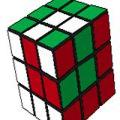
Pick up a Rubik’s Cube and count:
Edge pieces correspond to 〈110〉 → 12 pieces.
Corner pieces correspond to 〈111〉 → 8 pieces.
The dimensionless radius  , multiplied by half of the lattice constant, gives the actual cluster radius. If the lattice constant is in Å, the cluster radius is also in Å. Thus, in the Rubik’s Cluster Shell Model, computing the cluster shells requires only one variable:

where  is the lattice constant. Coordination numbers are already contained in 〈hkl〉, and
  .
.
Why does aluminum begin with 〈110〉 while iron (α‑Fe) begins with 〈111〉? Because aluminum originates from space group No. 225 and iron from No. 229. When I let these crystals “settle into” space group No. 221 — borrowing a bit of Chinese humor about “getting a hukou” — their generators become different:
Aluminum’s generators become ⟨000⟩ and ⟨110⟩.
α‑Fe’s generators become 〈000〉 and 〈111〉.
It is important to emphasize that the point‑group decomposition method used in this work is a strictly mathematical theory. I first applied the Oh point group to decompose many Rubik’s Cube move sequences, and only after verifying — by direct Rubik’s Cube inspection — that every decomposition was correct, did I extend the same method to the decomposition of space groups. This mathematical rigor is the foundation that makes the entire framework reliable.
https://blog.sciencenet.cn/blog-2321-1554200.html
上一篇:养博七千日,用博三四天:博客传播魔方晶体学实战案例
下一篇:Al助手“小魔方”写的文献综述:二十面体(Ih 点群)团簇壳层模型与准晶研究

全部作者的精选博文
全部作者的其他最新博文
- • Geometric Breakdown of the 20,000th Shell(被点评)
- • Distribution of 26,668,666,740,001 atoms in a quasicrystal
- • The Magic Numbers of Ih Quasicrystal Beyond 20,000 shells
- • An n-shell Lattice Model for 3D Quasicrystals:2-shell QC
- • 我大战Al群体50个回合
- • An n-shell Lattice Model for 3D Quasicrystals:1-shell QC