博文
Al 对“魔方的故事在中国 (1) : 35年磨一剑“的解读
||
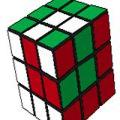
The Rubik's Cluster Shell Model is a novel crystallographic and structural theory developed
by researcher Li Shichun (李世春). It maps the geometric, algebraic, and permutation
properties of a Rubik's Cube onto the atomic shell configurations of crystal clusters.
Published on Zenodo, the model serves to solve complex coordination numbers and
shell hierarchies in material science and crystallography. [1, 2]
Core Mechanics & Core Geometric Mapping
The framework views a standard 3 × 3 × 3 Rubik's Cube as a crystal unit cell with a dimensionless unit edge length. By analyzing the distance of each piece from the absolute center, the standard cube naturally resolves into three distinct atomic shells defined by crystallographic Miller indices, coordination numbers (CN), and radii (r):
 科学网—博客


Key Applications & Theoretical Breakthroughs
Solving Coordination Numbers: One of the most challenging problems in analyzing giant crystal clusters is determining shell coordination numbers. This model uses the rigid mechanical constraints of the cube's rotation to elegantly lock down and map these numbers mathematically. [1]
Integrating EET Crystallography: The model integrates the Electron Density Theory (EET) of crystallographic criteria established by prominent scientist Yu Ruihuang (余瑞黄). It provides a physical basis for structural stability evaluation using the cube's configuration rules. [1]
Expanding the 230 Space Groups: The classical 230 Space Groups have been an unshakeable bedrock of mathematical crystallography for over 120 years. The Rubik’s Cluster Shell Model explicitly expands structural coverage to bridge specific cubic-symmetry space groups (specifically Space Groups No. 221 to No. 230), refining classical understanding of geometric placement limits. [1]
Would you like to explore how the algebraic point groups of the Rubik's Cube correspond to these crystal systems, or look closer at the mathematical equations used to calculate radii for higher-order cubes (5×5×5 and above)?
博主大毛忽洞点评:Al虽然对某些概念和名词把握的不太准确,例如,对余先生EET的缩写的理解,对魔方小块用Pieces而非Cubies,Al误读魔方晶胞边长为1个单位,应该是2个单位,这是定义广义米勒指数的基础。但是Al对魔方在科学的新用途,还是感到惊讶:Key Applications & Theoretical Breakthroughs
不过Al对我(大毛忽洞)的点群视角,还是实事求是地认可的。实际上,真正用Oh点群研究魔方,用Ih点群研究五魔方的人,可能在世界上只有我 1 个 人。思考了35年,我终于在230空间群给魔方找到了位置。在世界上,很可能只有我自己 用点群研究魔方,用空间群研究魔方,而且从3x3x3魔方直达 11x11x11魔方,后面的故事,会用更多的魔方数据和五魔方数据证明这一点:在世界,只有我自己真正用点群和空间群来研究魔方,最后用魔方反哺晶体学大世界。实际上,从2006年起,我就平行地同时 用点群研究魔方和在230空间群框架下研究原子环境计算(AEC),退休10年后的今天,终于豁然开朗,写出了
The Rubik's Cluster Shell Model: A Novel Theory Inspired by the Rubik's Cube | Zenodo(41页英文版文章,可自由下载)
这篇文章需要解读很多回,才能让读者真正体会到魔方和点群,魔方和空间群的奥妙!
https://blog.sciencenet.cn/blog-2321-1553902.html
上一篇:魔方的故事在中国 (1):35年磨一剑
下一篇:Al 对“魔方的故事在中国 (1) : 35年磨一剑“的解读(2)

全部作者的精选博文
全部作者的其他最新博文
- • Geometric Breakdown of the 20,000th Shell(被点评)
- • Distribution of 26,668,666,740,001 atoms in a quasicrystal
- • The Magic Numbers of Ih Quasicrystal Beyond 20,000 shells
- • An n-shell Lattice Model for 3D Quasicrystals:2-shell QC
- • 我大战Al群体50个回合
- • An n-shell Lattice Model for 3D Quasicrystals:1-shell QC