博文
刊•见 | 环境与生态学领域SCI期刊,聚焦植物修复技术的创新与实践  精选
精选
||
随着全球环境问题的日益严峻,寻找可持续且生态友好的解决方案成为当务之急。植物修复技术作为一种创新的环境治理方法,正在全球范围内得到广泛关注和应用。传统的植物修复主要集中于清除土壤和地下水中的有害污染物,而如今,这一技术已扩展到更广泛的领域,涵盖了城市、农田及其他与人类活动密切相关的景观中的自然资源管理挑战。
本期【刊•见】为诸位介绍环境科学领域期刊—International Journal of Phytoremediation。除了对期刊进行详尽的介绍外,还将向您介绍近一年高阅读量文章:
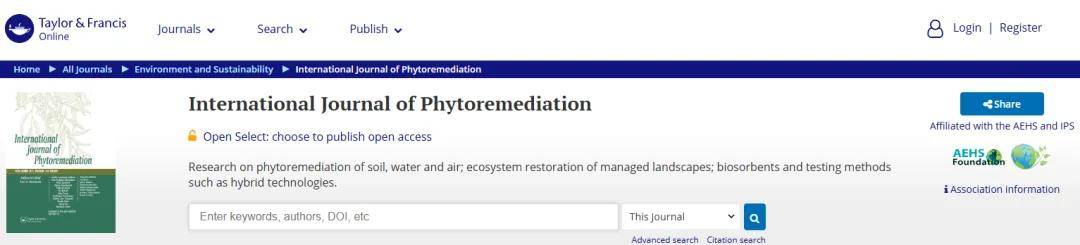 Print ISSN: 1522-6514 Online ISSN: 1549-7879
International Journal of Phytoremediation是首本专注于发表实验室与实地研究成果的期刊,阐述如何利用植物系统修复土壤、水和空气质量,以及通过恢复管理景观中的生态系统服务来实现环境改善。传统的植物修复技术主要集中于清理土壤及地下水中的有害污染物。而今,植物技术已扩展了这一领域,涵盖了我们在城市、农场以及与日常公众活动更紧密结合的其他景观中面临的许多自然资源管理挑战。例如,用于处理废水的湿地、处理雨水径流的雨水花园、控制污染物的杨树种植、处理空气污染的城市树冠,以及处理退役矿区的特殊植物,都是植物技术的典型案例。
International Journal of Phytoremediation的研究范围包括:
使用传统的植物修复工艺,如植物降解、植物稳定化、植物挥发、植物萃取(包括根过滤)和增强根际生物降解,进行环境修复
将化学、物理和/或其他生物过程与植物修复相结合的混合技术
从基础实验室研究和台架测试到试点和全面现场应用的任何技术开发和验证阶段
现场应用或描述污染物及其他形式的压力对植物修复系统的影响
专门用于确定植物技术局限性的植物毒性研究(筛选、调查)
植物监测
污染基质的植物管理
人工湿地、雨水径流清理以及植被覆盖/封盖
比较植物衍生的生物吸附剂与未经加工的植物材料或无生物吸附剂的修复的研究
探讨植物修复的社会框架,包括监管、经济和公众认知问题
该期刊已被SCIE, Scopus, CABI等数据库收录。
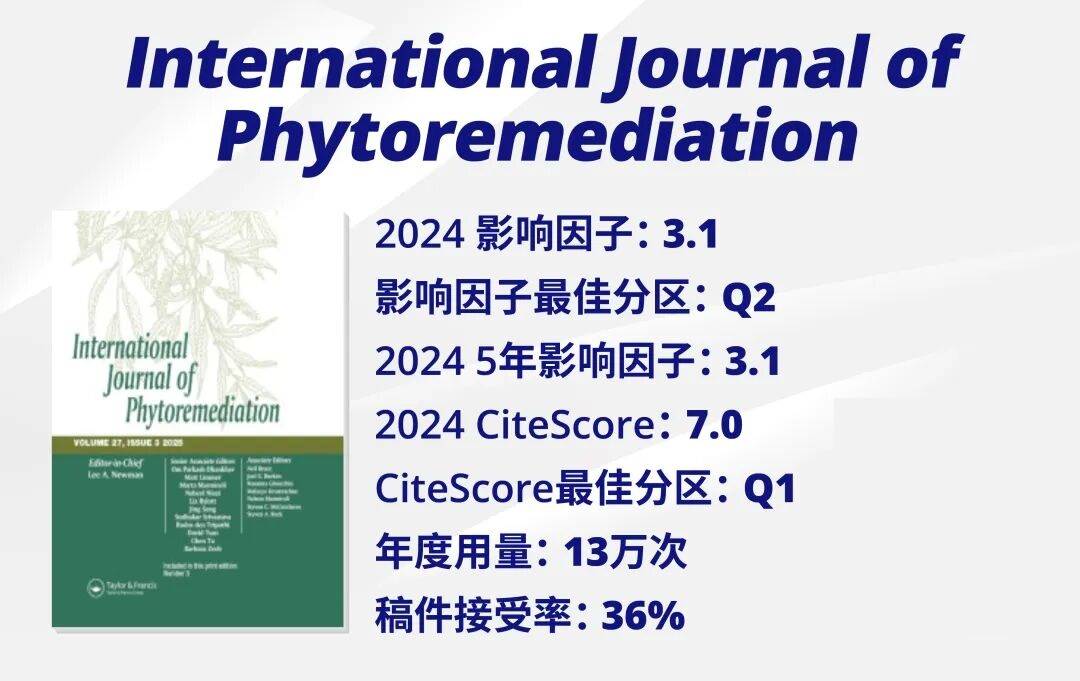
根据JCR显示, International Journal of Phytoremediation
在环境科学领域排名 187/376
根据Scopus显示, International Journal of Phytoremediation
在农业和生物科学:植物科学领域排名 66/534
在环境科学:污染研究领域排名 47/176
在环境科学:环境化学领域排名 54/150
接收文章类型
International Journal of Phytoremediation 主要内容由高质量的原创文章组成,同时也接受技术笔记、简短通讯、社论以及特邀综述文章的投稿。此外,该刊还刊登致编辑的信、书籍/软件评论、新产品和专利信息,以及即将举行的会议和课程的公告。
审稿周期
稿件一旦接受后,在线出版平均需要15天
编辑团队International Journal of Phytoremediation 由美国马萨诸塞大学(University of Massachusetts, USA) 的Guy R. Lanza博士创刊,现任主编为美国康涅狄格州农业实验站(The Connecticut Agricultural Experiment Station, USA)的Jason C. White博士。期刊的编辑团队由美国、中国、英国、意大利等国家及地区的行业翘楚组成。
主编
Jason C. White
Jason C. White,现任美国康涅狄格农业实验站主任,该实验站是美国历史最悠久的农业实验站。他的主要研究项目聚焦于食品安全与保障,特别关注利用纳米技术减少作物病害、提高农用化学品的施用效率,以及纳米材料对农业植物的广泛影响。
中国副主编
郭彬
郭彬,浙江省农业科学院环境资源与土壤肥料研究所副所长、所工会主席,主要的研究方向包括土壤重金属污染防治:重金属在土壤-作物体系迁移阻控机制与技术,土壤重金属有效性调控材料研发,土壤修复技术;土壤改良利用:浙江滨海、红壤中地产田地力提升。
宋静
宋静,中国科学院土壤环境与污染修复重点实验室研究员,研究领域为土壤环境基准与标准制定、污染土壤物化修复技术研发、决策单元多点增量采样方法。
唐荣贵
唐荣贵,浙江农林大学环境与资源学院专任教师,主要从事土壤动物介导的土壤碳氮循环研究和新型污染物对蚯蚓的生态毒理研究。
涂晨
涂晨,中国科学院南京土壤研究所任副研究员。主要研究方向为土壤复合污染过程与生物修复,环境微塑料与生物膜的相互作用及生物降解。
王树凤
王树凤,中国林业科学研究院亚热带林业研究所研究员,研究方向为:树木逆境(盐胁迫、重金属胁迫)响应的生理生态学机制、针叶树生殖生理调控。
魏树和
魏树和,现就职于沈阳应用生态研究所,研究领域为污染土壤修复、陆生生态毒理学、农业环境保护、农产品安全生产。
曾鹏
曾鹏,中南林业科技大学生态环境学院副教授,长期从事土壤重金属污染控制与修复、植物逆境生理响应、矿山生态修复等方面的科研。
张开梅
张开梅,南京林业大学生命科学学院副教授,主要从事蕨类植物领域的教学和科研工作。
作者分布根据JCR显示,近三年在 International Journal of Phytoremediation发文的国家中,发文比较活跃的是:
中国
印度
巴基斯坦
近三年,在International Journal of Phytoremediation发文的全球高校和科研机构中,发文比较活跃的是:
沙特国王大学
费萨拉巴德农业大学
埃及数据库
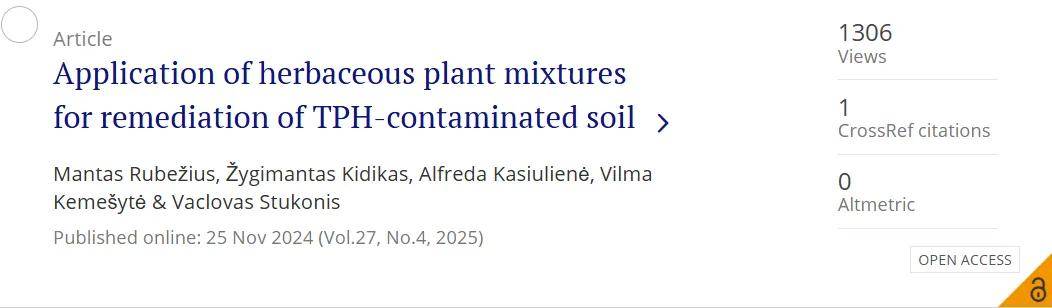
作者:Mantas Rubežius et al.
Soil pollution with petroleum products is an urgent public health and environmental problem. Therefore, innovative solutions for cleaning soils contaminated with petroleum products are needed. One such solution is rhizodegradation, which is recognized as a sustainable and effective method of in situ soil remediation. Much of the previous research was done with monocultures, therefore the effects of different combinations of plants on the removal of petroleum products remain ambiguous. These studies evaluated three different herbaceous plant mixtures for the removal of total petroleum hydrocarbons (TPHs) from contaminated soil. Promising results were obtained. Selected herbaceous plant species and their mixtures can be successfully grown in contaminated soil at a contamination level of 6,817 mg/kg TPH DW according to the selected cultivation strategy. After applying a complex of biotechnology and agronomic solutions, the morphological and morphometric indicators revealed the good adaptability and tolerance of the selected herbaceous plants to growing in contaminated soil. After two years of pot testing application of different mixtures of herbaceous plants, the TPH (C6–C40) removal potential reached 85–90%.
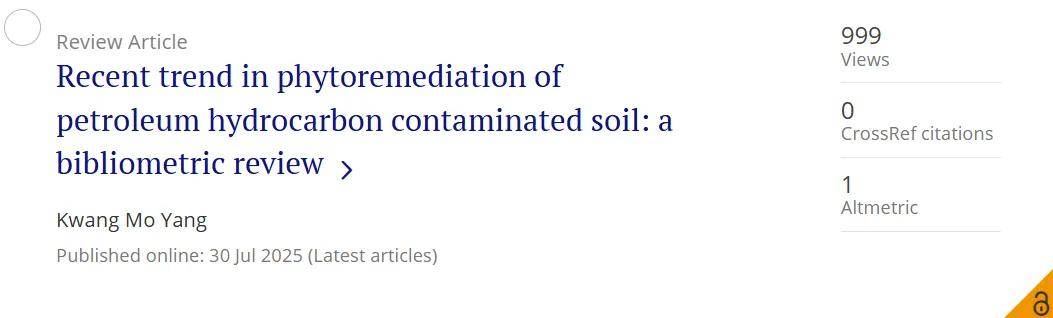
作者:Kwang Mo Yang
Phytoremediation is an environmentally friendly and low-cost technology for remediating petroleum contaminated soils. This review analyzed the publications indexed in the Scopus database between 2015 and 2025. The number of publications and citations related to the phytoremediation of petroleum hydrocarbons has increased rapidly, presumably due to the growing environmental pollution of petrochemicals worldwide. China emerged as the most productive country, followed by India and the United States, respectively. The majority of publications were found in Environmental Science and Pollution Research, International Journal of Phytoremediation, Chemosphere, Science of the Total Environment, and Journal of Hazardous Materials. The top five keywords in this field were bioremediation, polycyclic aromatic hydrocarbons, petroleum hydrocarbons, rhizoremediation, and heavy metals, excluding phytoremediation. The keyword analysis showed a focus on co-contaminated soil, plant-microbial interaction, amendment-assisted phytoremediation, and phytotoxicity. This bibliometric review provides valuable insights for future directions related to the phytoremediation of petroleum hydrocarbons.
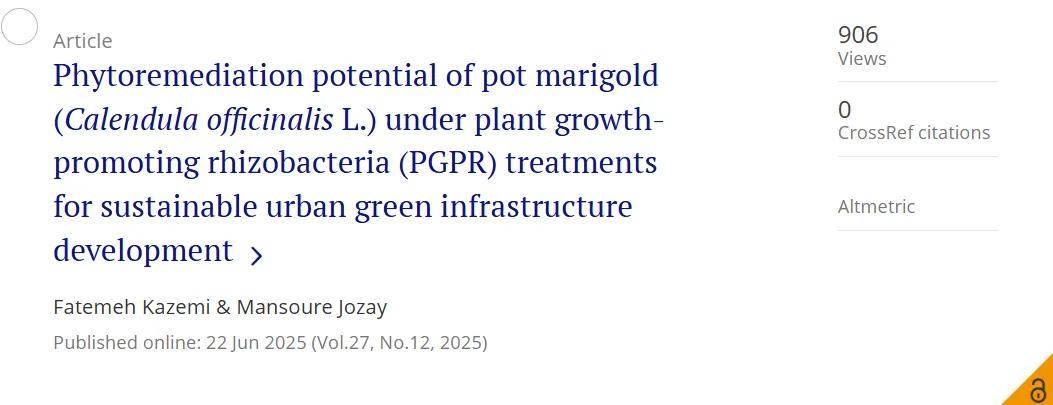
金盏花(Calendula officinalis L.)在植物生长促进根际细菌(PGPR)处理下的植物修复潜力及其对可持续城市绿色基础设施发展的应用
作者:Fatemeh Kazemi & Mansoure Jozay
This study evaluated the phytoremediation potential of pot marigolds on green wall systems for removing soil cadmium. The experiment was a factorial arrangement in a randomized complete block design. The first factor was cadmium (0, 1, 2, and 3 mg/kg soil), and the second was seven single or mixed plant growth-promoting rhizobacteria (PGPR) and the control treatments. All root and flower-related traits significantly increased after bacterial treatments (p ≤ 0.05). Substrates inoculated with Thiobacillus thioparus strain 300, Mix2 (Aztobactor chorococcum strain D0941 + Azosporillum liposferum strain So131), and Mix3 (Thiobacillus thioparus strain 300+ Pseudomonas putida strain G0951+ Aztobactor chorococcum strain D0941+ Azosporillum liposferum strain So131) increased phytoremediation of pot marigold in roots and shoots up to 3 mg/kg soil cadmium. The transfer factor (TF) was under one in flowers, showing the low potential of the flowers for phytoremediation. TF was above one in aerial vegetative plant sections, indicating the species as a cadmium accumulator and extractor for managing cadmium contaminant sites. Based on purification ratios and transfer factors, Thiobacillus thiolates (alone or combined) is recommended for enhancing pot marigold esthetics in landscapes, while Pseudomonas strains (single or mixed) improve its phytoremediation potential in urban green infrastructure.
为帮助更多科研人员选择更加合适的期刊,Taylor & Francis推出专栏——刊·见,该专栏致力于为读者和广大科研人员带来Taylor & Francis旗下期刊的详细解读,从期刊的基本情况、编委阵容、社会影响力到审稿速度、高被引文章等实用信息,专栏将为您带来最详细的介绍,让您更加全面地了解Taylor & Francis旗下优秀的国际期刊,帮助更多中国卓越科研成果顺利在国际期刊上发表。
https://blog.sciencenet.cn/blog-3574014-1512584.html
上一篇:工程人的硬核书库:解决世界级难题,从这几本书开始(内含开放获取图书!)
下一篇:消化与内分泌九大热门主题征稿合辑