博文
科普稿:弯曲纳米碳主体与富勒烯的奇妙结合
||
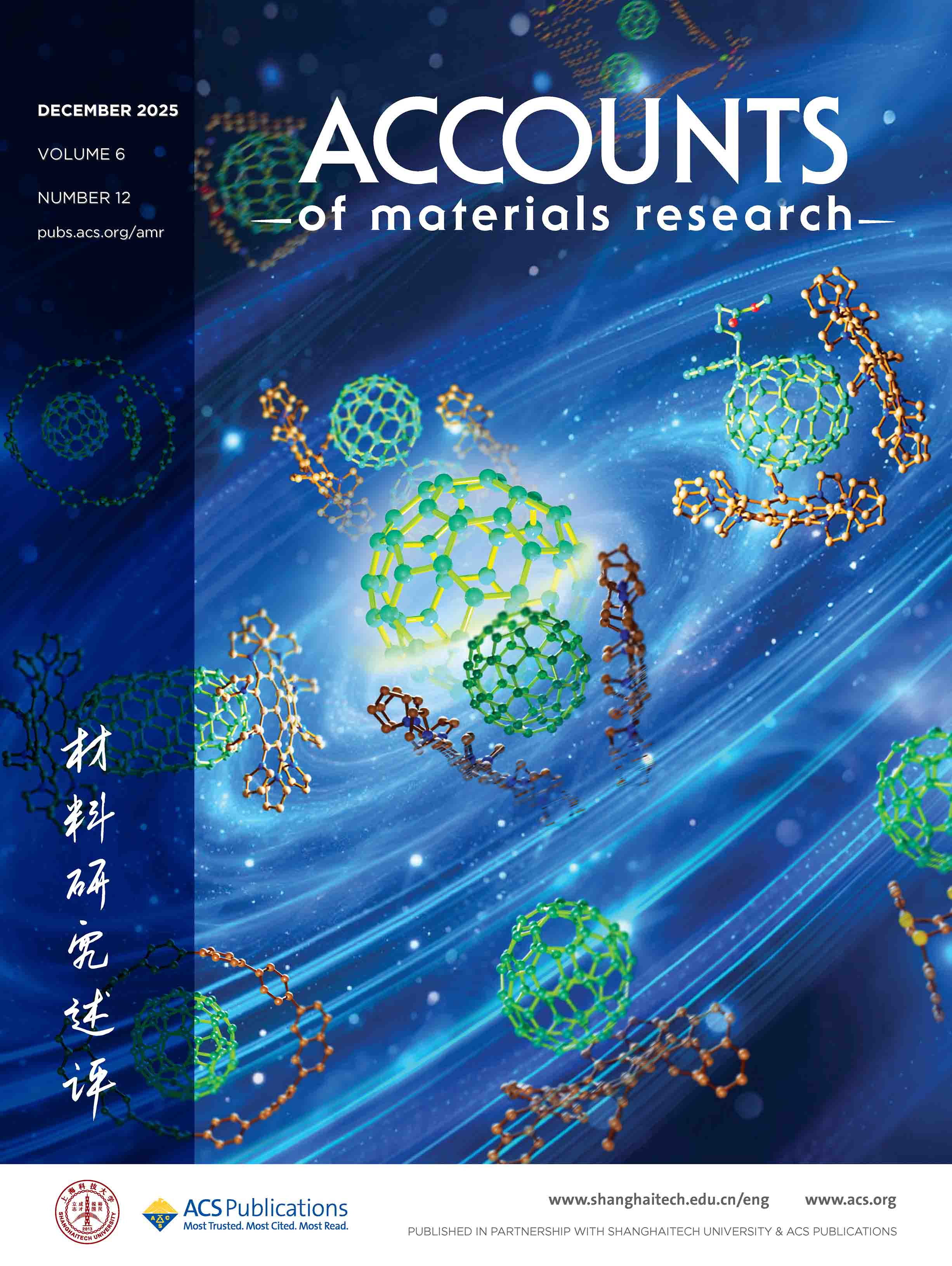
在纳米科技的微观世界里,弯曲纳米碳分子正绽放着独特的魅力。这些分子有着纳米级的尺寸和非平面的π表面,因其独特的物理化学性质吸引了众多科研人员的目光。分子的弯曲形态,比如环状、碗状、镊子状和笼状等,会从根本上改变其电子结构。与平面分子相比,弯曲让π键变弱,导致电子密度在凹面和凸面分布不均,还降低了最低未占据分子轨道(LUMOs)的能量。这些电子层面的变化带来了独特的光学行为、极性、电荷传输特性和自组装倾向。富勒烯,这种具有弯曲、缺电子球形π表面的分子,成为了超分子化学中的理想“客人”。当它们与互补的弯曲纳米碳“主人”结合时,能构建出具有先进功能的复杂组装体。例如,在有机场效应晶体管(OFETs)中可作为高性能电荷传输层;能通过动力学差异(如区分C60和C70)实现富勒烯的选择性提纯;还能在异质结中实现超快的光致电荷分离。然而,设计和精确构建弯曲纳米碳分子并非易事,因为弯曲的π框架存在高的分子内应变。科研团队为此开发了一系列合成策略,成功构建了四种主要类型的弯曲纳米碳主体。在研究中取得了许多重要进展。一方面,合成并组装了定制的纳米碳主体,像环状纳米石墨烯、能封装C60二聚体并使光致发光增强104倍的笼状纳米石墨烯、结合π - π和n - π相互作用实现高选择性的镊子状主体,以及碗状的巴基碗等。另一方面,主体 - 富勒烯复合物有诸多功能应用,如增强光电导性、实现高效太阳能电池,还能进行富勒烯的识别和结构分析。未来,科研人员还将聚焦于利用定制的手性弯曲纳米碳主体实现手性富勒烯的立体选择性识别和光学拆分,这有望为手性富勒烯基材料带来新的发展,开启富勒烯超分子化学的新篇章。
期刊
Accounts of Materials Research
标题
Curved Nanocarbon Hosts for Fullerenes: Design, Assembly, and Functionalities
作者
Qianyan Zhang,Ting Liu,Ziyang Gan,Yuan-Zhi Tan,Su-Yuan Xie
摘要
Curved nanocarbon molecules, characterized by their nanoscale dimensions and nonplanar π-surfaces, have attracted considerable research interest owing to their distinct physicochemical properties dictated by molecular topology. The introduction of curvature─manifested as hoops, bowls, tweezers, cages─fundamentally modifies electronic structures relative to their planar analogues: it weakens π-bonds, induces asymmetric electron density distribution across concave and convex surfaces, and lowers the energy of the lowest unoccupied molecular orbitals (LUMOs). These electronic perturbations lead to unique optical behavior, polarity, charge transport characteristics and self-assembly propensity. Fullerenes, with their curved, electron-deficient spherical π-surfaces, have emerged as ideal guests in supramolecular chemistry. Their complexation with complementary curved nanocarbon hosts enables the construction of sophisticated assemblies with advanced functionalities, such as high-performance charge transport layers in organic field-effect transistors (OFETs), selective purification of fullerenes via kinetic differentiation (e.g., C60 vs C70), and ultrafast photoinduced charge separation in heterojunctions.
A central challenge, however, lies in the design and precise construction of curved nanocarbon molecules, which is hampered by the high intramolecular strain inherent to curved π-frameworks. To address this, our group has developed and applied a suite of synthetic strategies─including flash vacuum pyrolysis (FVP), gold-mediated dimerization, incorporation of pentagon defects, meticulous design of active ring-closing motifs, and dynamic coordination-driven assembly─to successfully construct four principal types of curved nanocarbon hosts.
Key advances covered in this Account include the following: (i) Synthesis and Assembly of Tailored Nanocarbon Hosts. We have developed hoop-shaped nanographenes that exploit radial π-conjugation to form the first ternary CPP-based co-crystals; cage-like nanographenes capable of encapsulating C60 dimers with a record 104-fold photoluminescence enhancement; tweezer-like hosts that combine π–π and n−π interactions for high selectivity; and bowl-shaped buckybowls, notably the flexible, electron-rich decapyrrylcorannulene (DPC), whose molecular conformations and electronic properties dictate specific binding behaviors toward a wide range of fullerenes. (ii) Functional Applications of Host–Fullerene Complexes. These supramolecular systems exhibit enhanced photoconductivity, enable high-efficiency solar cells, and facilitate versatile fullerene recognition and structural analysis. Representative examples include sulfur-doped buckybowl–fullerene stacks that show a 400% increase in electrical conductivity; corannulene–C60 assemblies that serve as solution-processable electron transport layers (ETLs) in inverted perovskite solar cells (PSCs), achieving a record power conversion efficiency (PCE) of 21.69%; and the universal host DPC, which allows structural elucidation of 15 different fullerenes, including endohedral metallofullerenes (EMFs) and heterofullerenes.
Collectively, our work establishes curved nanocarbon hosts as transformative building blocks that bridge synthetic innovation and functional excellence. In this Account, we highlight the potential of these supramolecular systems in emerging applications such as photoconductivity, solar energy conversion, and precise molecular analysis. We also outline future directions, with an emphasis on stereoselective recognition and optical resolution of chiral fullerenes using tailored chiral curved nanocarbon hosts. Realizing such enantioselective platforms could unlock the potential of chiral fullerene-based materials and open a new chapter in fullerene supramolecular chemistry.
原文链接
https://pubs.acs.org/doi/10.1021/accountsmr.5c00038
<静远嘲风-南京>设计制作
购书链接:
☆科学的颜值:学术期刊封面故事及图像设计
https://item.jd.com/12802188.html
☆科技绘图/科研论文图/论文配图设计与创作自学手册:CorelDRAW篇
https://item.jd.com/13504674.html
☆科技绘图/科研论文图/论文配图设计与创作自学手册:Maya+PSP篇
https://item.jd.com/13504686.html
☆科技绘图/科研论文图/论文配图设计与创作自学手册:科研动画篇
https://item.jd.com/13048467.html#crumb-wrap
☆SCI图像语法-科技论文配图设计使用技巧
https://item.jd.com/10073529532924.html?bbtf=1
静远嘲风-南京(MY Scimage) 成立于2007年,嘲风取自中国传统文化中龙生九子,子子不同的传说,嘲风为守护屋脊之瑞兽,喜登高望远;静远取自成语“宁静致远”,登高莫忘初心,远观而不可务远。
学习更多绘图教程关注:


https://blog.sciencenet.cn/blog-519111-1518574.html
上一篇:2025年11月嘲风作品集(一)
下一篇:哇塞!质谱成像技术新突破