博文
2025年11月嘲风作品集(一)
||
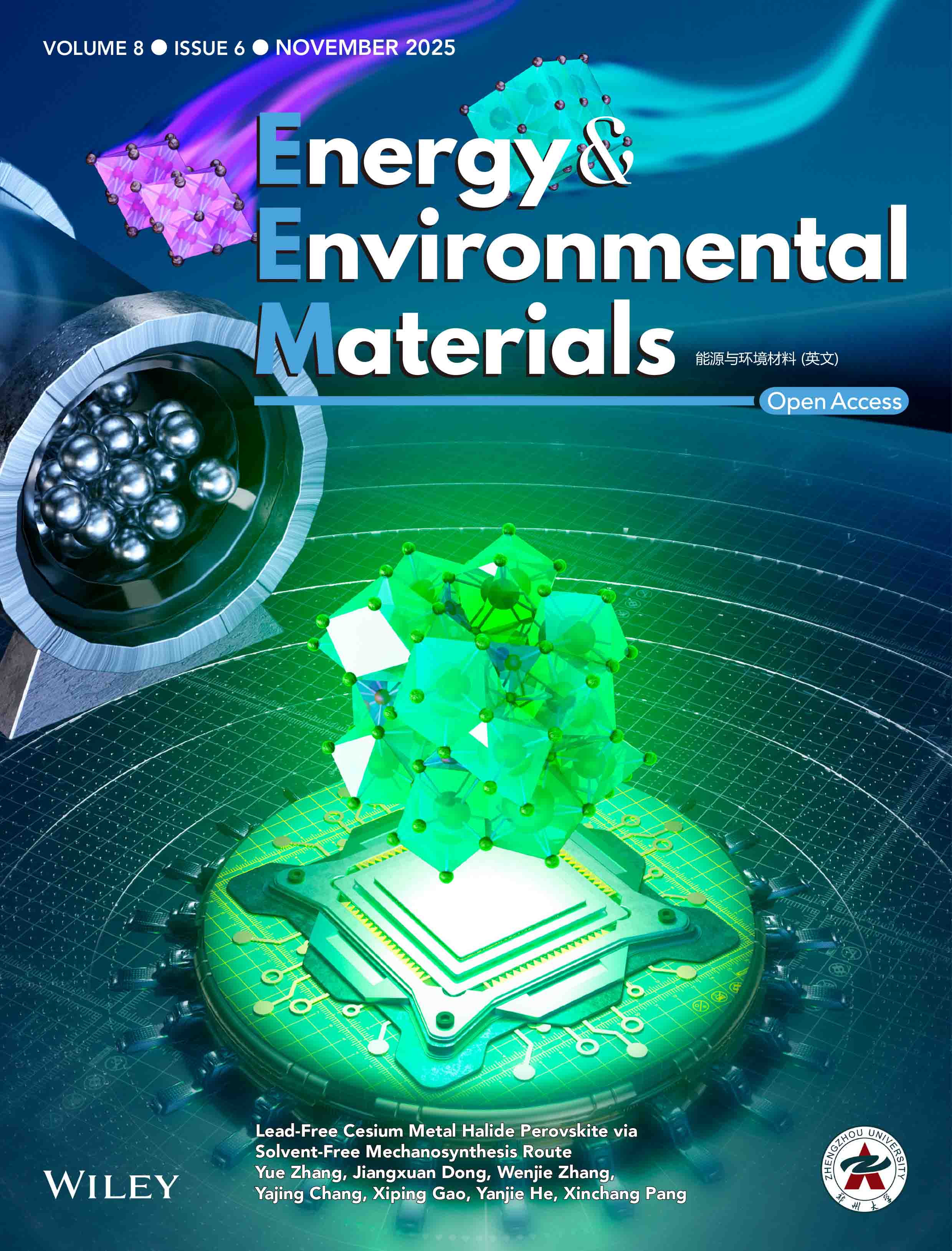
▲ Vol 08 Issue 06 | November , 2025
Lead-Free Cesium Metal Halide Perovskite via Solvent-Free Mechanosynthesis Route
Yue Zhang, Jiangxuan Dong, Wenjie Zhang, Yajing Chang, Xiping Gao, Yanjie He, Xinchang Pang
Recent advancements in lead halide perovskites opened up an avenue for vast optoelectronic applications. However, lead toxicity and the complicated synthesis process posed major obstacles to their further practical applications. To address these issues, a facile and robust mechanochemical synthesis of cesium manganese halide (Cs3MnX5, X = halide element) was developed via a highly efficient solvent-free ball milling strategy. This green approach exempted the utilization of any harmful organic solvents, thereby enabling the fast and cost-effective production of lead-free Cs3MnX5 with excellent optical properties. Cs3MnX5 perovskites with mixed halide compositions could also be readily fabricated through this eco-friendly approach at room temperature without any post-purification. Furthermore, the robustness of the ball milling strategy was proved by fabricating zinc-doped Cs3MnX5 perovskites with enhanced thermal stability and ambient stability. These features demonstrated that ball milling was highly efficacious for producing high-quality non-toxic halide perovskites, which could be used in light-emitting diodes.
https://onlinelibrary.wiley.com/doi/10.1002/eem2.70064
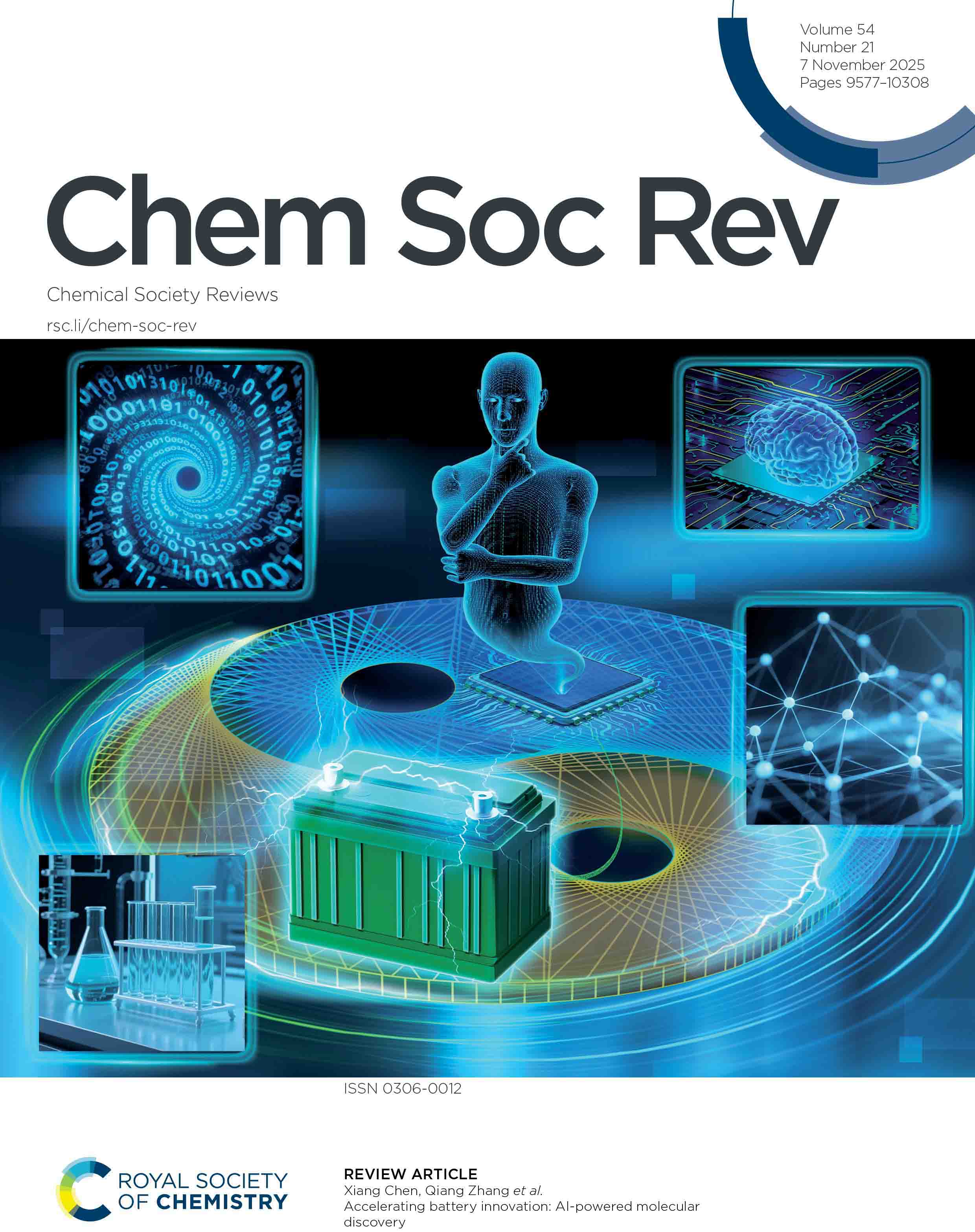
▲ Vol 54 Issue 21 | 07 November , 2025
Accelerating battery innovation: AI-powered molecular discovery
Yu-Chen Gao, Xiang Chen, Yu-Hang Yuan, Yao-Peng Chen, Yi-Lin Niu, Nan Yao, Yan-Bin Gao, Wei-Lin Li and Qiang Zhang
The global energy transition urgently demands advanced battery technologies to address current climate challenges, where molecular engineering plays a pivotal role in optimizing performance metrics such as energy density, cycling lifespan, and safety. This review systematically examines the integration of artificial intelligence (AI) into molecular discovery for next-generation battery systems, addressing both transformative potential and sustainability challenges. Firstly, multidimensional strategies for molecular representation are delineated to establish machine-readable inputs, serving as a prerequisite for AI-driven molecular discovery (Section 2). Subsequently, AI algorithms are systematically summarized, encompassing classical machine learning, deep learning, and the emerging class of large language models (Section 3). Next, the substantial potential of AI-powered predictions for key electrochemical properties is illustrated, including redox potential, viscosity, and dielectric constant (Section 4). Through paradigmatic case studies, significant applications of AI in molecular design are elucidated, spanning chemical knowledge discovery, high-throughput virtual screening, oriented molecular generation, and high-throughput experimentation (Section 5). Finally, a general conclusion and a critical perspective on current challenges and future directions are presented, emphasizing the integration of molecular databases, algorithms, computational power, and autonomous experimental platforms. AI is expected to accelerate molecular design, thereby facilitating the development of next-generation battery systems and enabling sustainable energy innovations.
https://pubs.rsc.org/en/content/articlelanding/2025/cs/d5cs00053j
<静远嘲风-南京>设计制作
购书链接:
☆科学的颜值:学术期刊封面故事及图像设计
https://item.jd.com/12802188.html
☆科技绘图/科研论文图/论文配图设计与创作自学手册:CorelDRAW篇
https://item.jd.com/13504674.html
☆科技绘图/科研论文图/论文配图设计与创作自学手册:Maya+PSP篇
https://item.jd.com/13504686.html
☆科技绘图/科研论文图/论文配图设计与创作自学手册:科研动画篇
https://item.jd.com/13048467.html#crumb-wrap
☆SCI图像语法-科技论文配图设计使用技巧
https://item.jd.com/10073529532924.html?bbtf=1

静远嘲风-南京(MY Scimage) 成立于2007年,嘲风取自中国传统文化中龙生九子,子子不同的传说,嘲风为守护屋脊之瑞兽,喜登高望远;静远取自成语“宁静致远”,登高莫忘初心,远观而不可务远。

学习更多绘图教程关注:


https://blog.sciencenet.cn/blog-519111-1516293.html
上一篇:2025年10月嘲风作品集(二)
下一篇:科普稿:弯曲纳米碳主体与富勒烯的奇妙结合