博文
Nucleolar organization in cell cycle
|
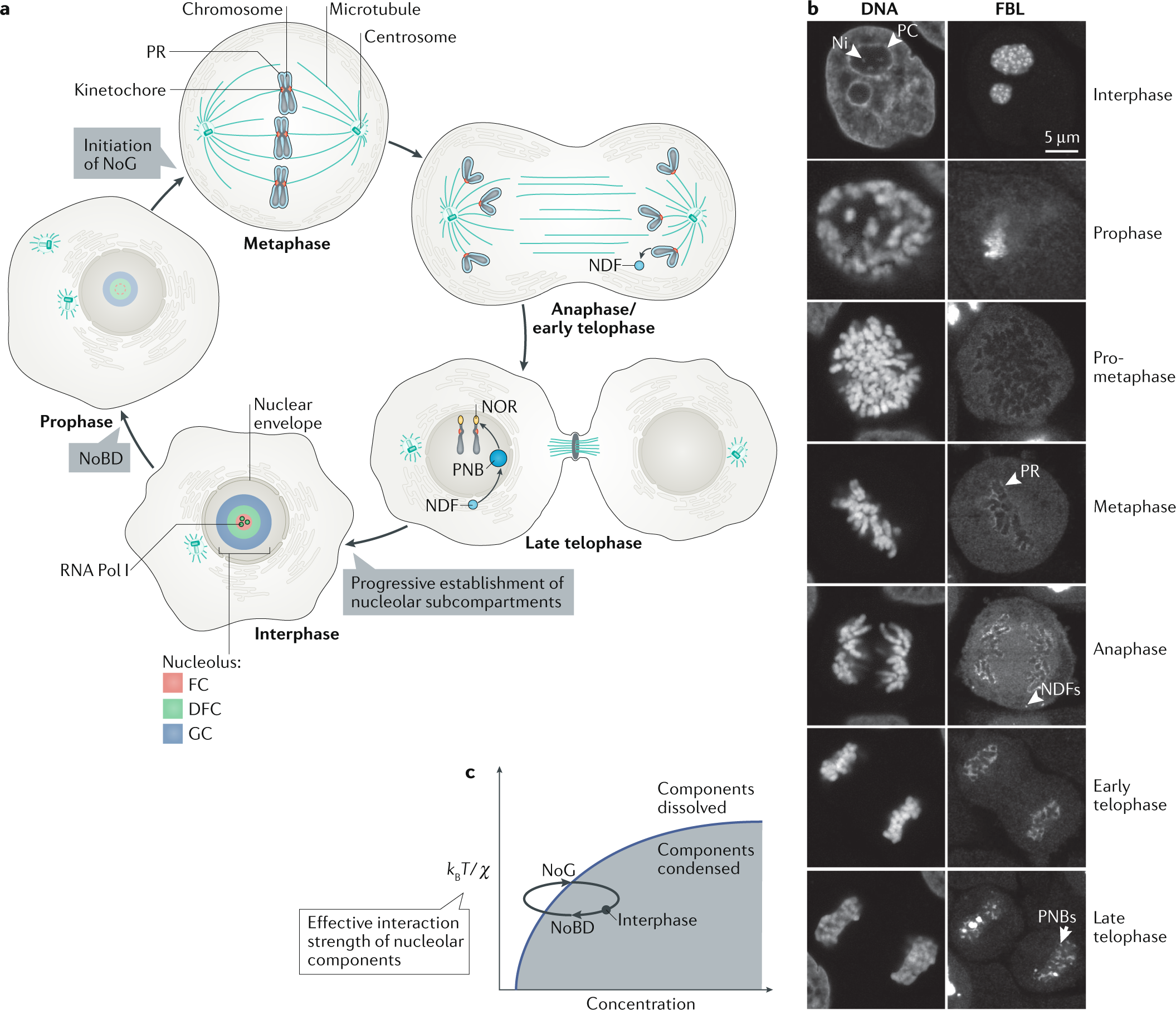
Picture from The nucleolus as a multiphase liquid condensate | Nature Reviews Molecular Cell Biology
Across the cell cycle, the nucleolus is not a static body but a highly dynamic condensate whose organization is tightly coupled to ribosome biogenesis and cell-cycle state. In interphase, it is the most prominent nuclear body and is organized as a multiphase condensate built around ribosomal DNA (rDNA) repeats and nascent pre-rRNA. In mammalian cells, this organization is typically described as three concentric or partially layered subcompartments: the fibrillar center (FC), where rDNA and the Pol I transcription machinery are concentrated; the dense fibrillar component (DFC), where early pre-rRNA processing occurs; and the granular component (GC), where later assembly steps of preribosomal particles take place. This spatial partitioning is not just morphological, but is functionally linked to the sequential steps of ribosome production and to the liquid-like behavior of the nucleolus as a condensate.
During interphase, nucleolar architecture reflects active ribosome biogenesis. rDNA transcription, pre-rRNA processing, and preribosome assembly are spatially organized across these subcompartments, allowing the nucleolus to function as a coordinated production line. Nucleolus a multiphase liquid system in which distinct biomolecular phases coexist with different material properties and molecular compositions. This helps explain both the internal stratification of the nucleolus and its ability to concentrate factors needed for ribosome synthesis while remaining dynamic and responsive to cellular conditions.
At the onset of mitosis, nucleolar organization is dismantled. Nucleolar breakdown accompanies mitotic entry, when ribosomal RNA synthesis is shut down and the canonical interphase nucleolus disappears. Rather than simply dispersing uniformly, many nucleolar components redistribute into mitotic structures. The perichromosomal region, a sheath-like condensate of nucleolar proteins surrounding condensed mitotic chromosomes, and nucleolar-derived foci (NDFs), small condensates that appear during mitosis. This means that nucleolar disassembly is a regulated reorganization of components, not a complete loss of nucleolar identity.
As cells progress through anaphase and telophase, nucleolar components begin to reassemble in a stepwise manner. Nucleolar proteins relocalize to NDFs in anaphase, and then, as the nuclear envelope reforms in telophase, prenucleolar bodies (PNBs) appear in the daughter nuclei. These PNBs are transient condensates containing nucleolar proteins and processing factors, and they act as intermediates in nucleolar reformation. Their emergence illustrates that nucleolar reassembly is not instantaneous; instead, the daughter-cell nucleolus is rebuilt through ordered condensate transitions as ribosome biogenesis is restarted.
In early G1, functional nucleoli are re-established around active nucleolar organizer regions (NORs). Nucleolar genesis can be understood in condensate terms: once transcription restarts and nascent pre-rRNA becomes available, it helps nucleate the re-formation of nucleolar phases. Thus, post-mitotic nucleolar assembly depends not only on protein relocalization but also on renewed RNA production, which helps organize the FC, DFC, and GC-like architecture of the mature nucleolus. The nucleolar cycle mirrors the cell cycle: active, layered condensates in interphase; disassembly and redistribution during mitosis; then progressive reassembly as cells return to G1.
Conceptually, nucleolar organization in the cell cycle is best understood as a dynamic condensate cycle. Interphase nucleoli are structured, multilayered bioreactors for ribosome production; mitosis drives their dissolution into chromosome-associated and cytoplasmic intermediates; and mitotic exit rebuilds them through NDFs and PNBs into new daughter-cell nucleoli. This framework is useful because it links morphology, biophysics, and function: the nucleolus changes shape and composition across the cell cycle because ribosome biogenesis itself is cyclically turned off, redistributed, and then reactivated.
https://blog.sciencenet.cn/blog-3545398-1529696.html
上一篇:CTCF及转录影响有丝分裂后的染色质结构重构
下一篇:液体中分子的结合记忆

