博文
SERS Nanoplatform for Bacterial Tracking and Wound Healing
|
Dual-Functional Silent-Region SERS Nanoplatform for Real-Time Bacterial Tracking and Wound Healing Therapy
Hanbin Deng,Rui Wang,Dianqi Zhang,Wei Zhang,Jaebum Choo,Fabiao Yu,Shaowen Cheng
First published: 13 July 2026
https://doi.org/10.1002/advs.76574
Hanbin Deng, Rui Wang, and Dianqi Zhang contributed equally to this work.
ABSTRACT
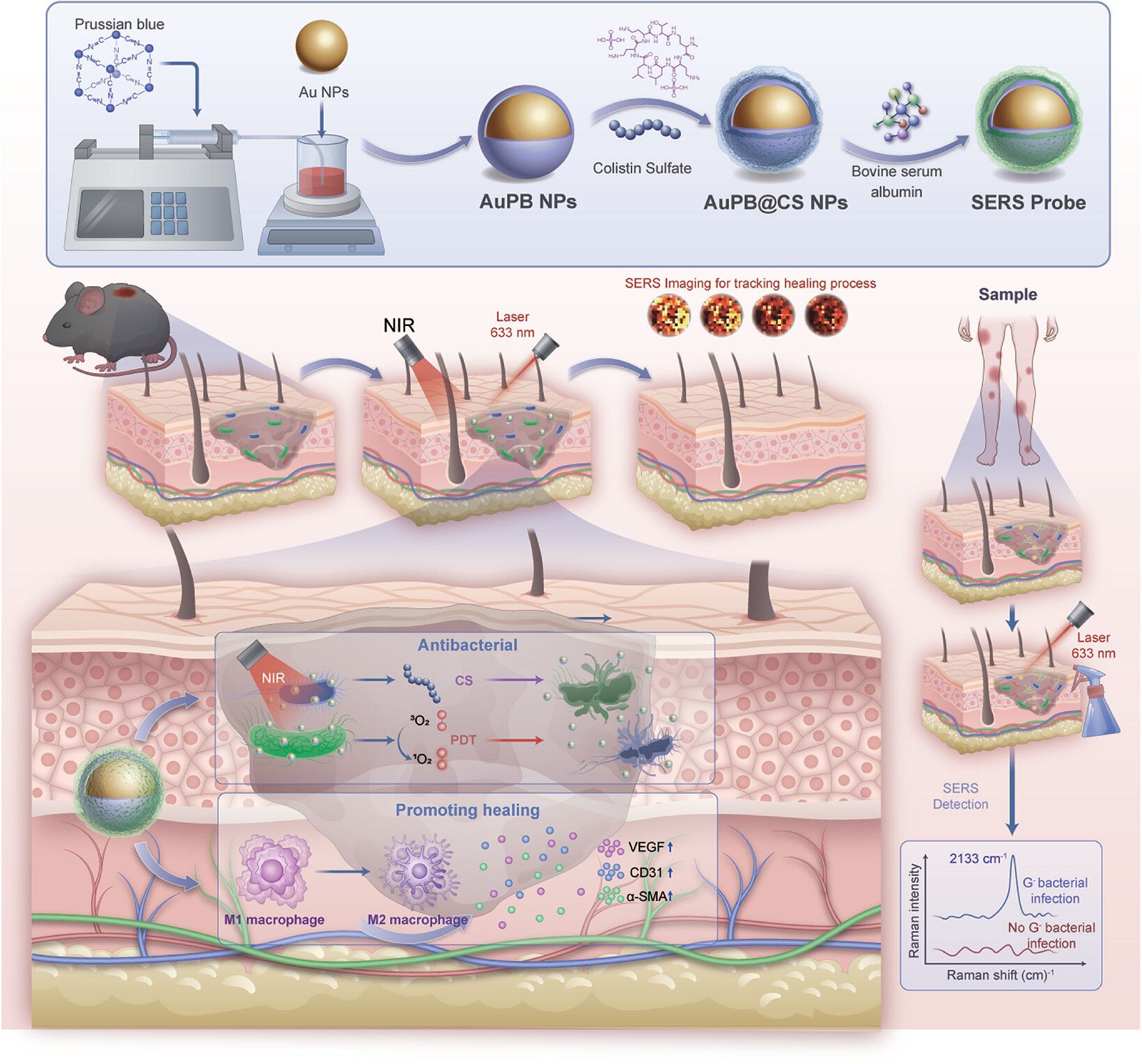
Bacterial wound infections, particularly those caused by Escherichia coli and Pseudomonas aeruginosa, are difficult to treat due to biofilm formation, multidrug resistance, and chronic inflammation. Here, we report a multifunctional nanoplatform based on a surface-enhanced Raman scattering (SERS) probe that enables simultaneous photodynamic therapy, antibiotic delivery, and real-time infection monitoring. The probe comprises gold nanoparticles coated with Prussian blue, which acts both as a near-infrared photosensitizer and a Raman reporter in the spectroscopically silent region, further loaded with colistin sulfate and stabilized with bovine serum albumin. Upon irradiation with a 650 nm laser, the probe produces reactive oxygen species, and, in combination with antibiotic release, achieves enhanced eradication of Gram-negative bacteria (>90% reduction) using a significantly reduced antibiotic dose. The SERS signal in the silent region enables background-free, in situ discrimination and quantification of bacterial load during treatment. In both normal and diabetic mouse wound models, the probe accelerates bacterial clearance, facilitates M2 macrophage polarization, and promotes angiogenesis and collagen deposition, thereby resulting in improved wound healing. Analysis of 36 clinical wound samples demonstrates sensitive and specific Gram-positive and negative bacterial identification. This approach establishes a clinically translatable strategy for precise infection management, real-time monitoring, and enhanced wound repair.
3 Conclusion
Bacterial wound infection remains one of the clinical challenges in both acute and chronic wound care, primarily due to biofilm formation, multidrug resistance and persistent inflammation that delay tissue repair and increase the risk of recurrence. Conventional antibiotic therapy alone often provides insufficient, since high dose administration not only increases systemic toxicity but also accelerates resistance development. Moreover, currently available diagnostic approaches, such as culture or PCR, are time-consuming, invasive, or incapable of distinguishing viable from dead bacteria.
Here we report a multifunctional Raman-silent-region SERS probe that integrates PB-mediated PDT, CS-based antibiotic delivery, and real-time infection monitoring. The proposed platform differs substantially from conventional theranostic systems that typically depend on exogenous Raman tags or single-modality antibacterial strategies. In contrast, it exploits the intrinsic silent-region Raman signal of PB for simultaneous interference-free bacterial detection and photodynamically induced antibacterial action. This dual role of PB functioning both as photosensitizer and Raman reporter, directly addresses long-standing challenges in achieving concurrent bacteria killing and monitoring in infected wounds.
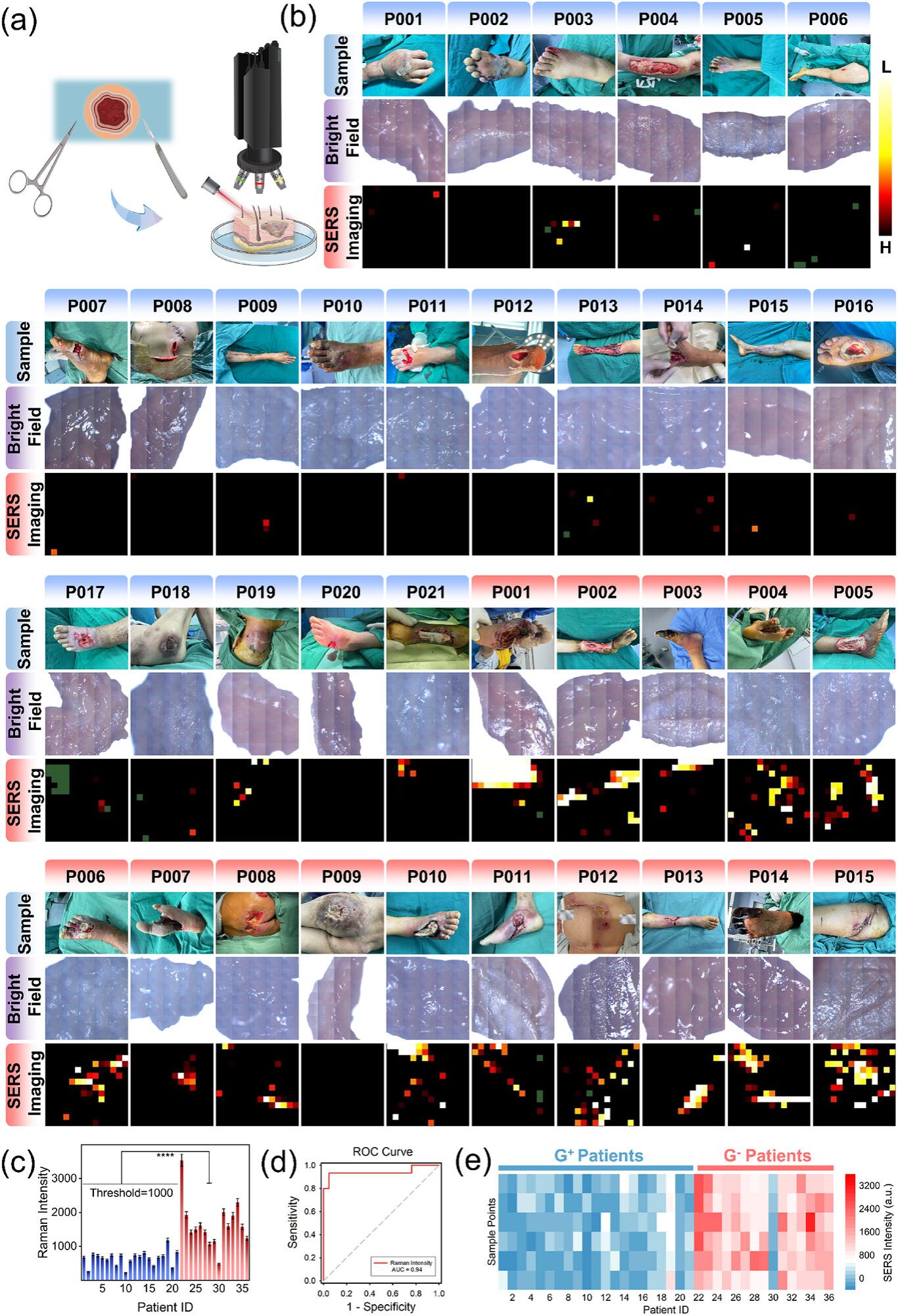
The combined antibacterial mechanism of PB-mediated PDT and CS release proved critical in overcoming the limitations of monotherapy. Under near-infrared irradiation, the PB shell efficiently generated singlet oxygen, which disrupted bacterial membranes and damaged intracellular components. Meanwhile, CS selectively bound to the outer membrane of Gram-negative bacteria, thereby enhancing permeability and promoting cell lysis. This combined mechanism achieved > 90% reduction of E. coli and P. aeruginosa populations, achieved with significantly reduced antibiotic dosages, thus lowering the risk of resistance development. In vivo, these outcomes translated into accelerated wound closure in both BALB/c and diabetic models, accompanied by reduced bacterial burden, enhanced M2 macrophage polarization, angiogenesis and collagen deposition. More importantly, silent-region SERS imaging enabled real-time, non-invasive monitoring of bacterial load for evaluation of therapeutic efficiency. This strategy achieved robust and interference-free signals to discriminate Gram-positive and Gram-negative infections. Clinical validation using 36 patient samples further confirmed its diagnostic robustness, yielding an AUC of 0.94.
The SERS probe also demonstrated an excellent biosafety prfile supported by stable body weights, normal serum biochemistry, and lack of histopathological toxicity in treated animals. Although CS was chosen for Gram-negative coverage, incorporation of alternative or broad-spectrum antibiotics could really extend the platform to mixed bacterial infections. Likewise, optimization of PB shell properties could further enhance ROS yield, drug release dynamics, and systemic biodistribution. Nevertheless, there are still some challenges. Validations in large animal models is necessary to fully recapitulate the pathophysiological complexity of human wounds. Meanwhile, systematic studies on long-term biodistribution, clearance, and repeated dosing safety are also warranted. Beyond wound infections, the design principles demonstrated here, integrating silent-region Raman diagnostics with multifunctional therapy, could be broadly extended to address implant-related infections, osteomyelitis, or even respiratory diseases.
In conclusion, we developed a multifunctional Raman-silent SERS probe that combines photodynamic therapy, antibiotic release, and real-time bacterial monitoring for effective management of infected wounds. Utilizing Prussian blue not only as a Raman reporter in the spectroscopically silent region but also as a photosensitizer for ROS generation, the probe enables precise, background-free SERS detection alongside combined antibacterial activity when combined with CS. Comprehensive in vitro and in vivo studies, including diabetic wound models, verified robust bacterial clearance, accelerated tissue repair, immunomodulation via macrophage polarization, and enhanced angiogenesis and collagen deposition. Furthermore, clinical testing confirmed its capability to accurately discriminate Gram-positive and Gram-negative infections. This integrated theranostic platform offers a promising and translationally relevant strategy for managing complex bacterial infections and promoting wound regeneration.
https://blog.sciencenet.cn/blog-2438823-1543851.html
上一篇:H2O2/viscosity dual-responsive fluorescent probe for redox
下一篇:Fluorescent Probe for Imaging Nitroxyl in Liver Injury


全部作者的其他最新博文
- • phosphorescent iridium (III) probes for selenocysteine
- • Sequential recognition of hydrogen polysulfides and formalde
- • Reversible Imaging of the HOCl/GSH Redox Cycle
- • Near-Infrared Imaging of Glycerol-3-Phosphate Dehydrogenase
- • two-photon probe fo hydrogen polysulfides and formalde
- • The therapeutic of metformin in articular cartilage repair