博文
Fluorescent Probes for Ag+ and Hg2+ Sensing- A Review
|
Review Published: 05 May 2026 Volume 10, pages 433–465 (2026)
Yu, C., Wang, Z., Yang, M. et al. Decoding Soft Metals Multifunctional Fluorescent Probes for Selective Ag+ and Hg2+ Sensing. J. Anal. Test. 10, 433–465 (2026). https://doi.org/10.1007/s41664-026-00452-8
https://link.springer.com/article/10.1007/s41664-026-00452-8
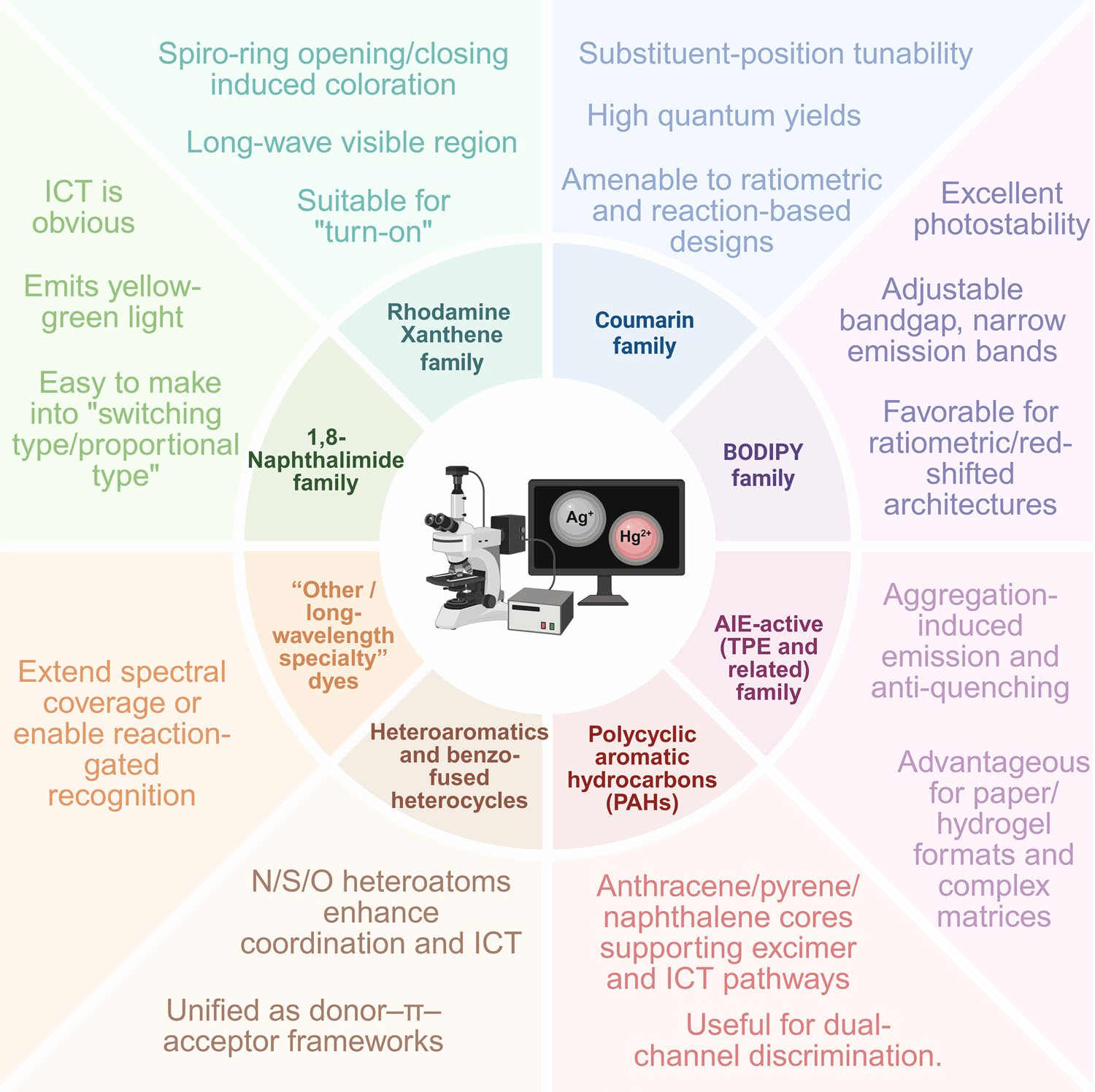
AbstractAg+ and Hg2+ are soft, thiophilic cations of high environmental and biomedical relevance, yet their closely related coordination preferences make differential sensing nontrivial. This review surveys multifunctional fluorescent probes that discriminate or simultaneously report Ag+/Hg2+, organized by fluorophore scaffold and transduction mechanism. Across eight scaffold classes, 1,8-naphthalimide, rhodamine/rhodol/xanthene, coumarin, BODIPY, aggregation-induced emission (AIE)-active (e.g., tetraphenylethene), polycyclic aromatics (anthracene/pyrene/naphthalene), heteroaromatics and benzo-fused heterocycles (pyridine, thiophene, benzimidazole/oxadiazole/benzothiadiazole, naphthyridine, triarylamine), and long-wavelength specialty dyes (squaraine, anthraquinone, phosphinine), we map recognition motifs (S/S, Se-enriched chelators, N,O-donor arrays, triazoles, crown/azacrown, thio/semicarbazide, thioketal) to signal transduction pathways, including intramolecular charge transfer (ICT) and photoinduced electron transfer (PET) modulation, chelation-enhanced fluorescence (CHEF)/ chelation-enhanced quenching (CHEQ), excited state intramolecular proton transfer (ESIPT), twisted intramolecular charge transfer (TICT), AIE, and reaction-gated conversions (e.g., rhodamine spirocyclic opening, desulfurization, thioketal cleavage). We compare response formats (turn-on/turn-off, ratiometric, lifetime/anisotropy), media compatibility (buffered aqueous solutions, paper/hydrogel strips, complex water matrices), and biological use cases (live-cell imaging), and benchmark figures of merit (dynamic range, limits of detection, binding stoichiometry/affinity, kinetics, photostability, and selectivity panels against Cu2+, Pb2+, Fe3+, alkali/alkaline-earth cations, and biologically relevant anions/thiols). Case studies highlight orthogonal readouts that enable Ag+/Hg2+ discrimination, such as distinct emission maxima, colorimetric shifts, reversible masking with chelators, as well as aggregation- or reaction-driven amplification suitable for portable formats. Persistent challenges include the demand for water-soluble, low-background probes that operate with minimal organic cosolvent, sustained performance in complex matrices, and red/near-infrared (NIR) emission for deep-tissue imaging. We conclude with design principles that emphasize atom-economical synthesis, biocompatible scaffolds, orthogonal binding sites, and dual-channel transduction as a route to robust, field-deployable, and bioimaging-ready Ag+/Hg2+ sensors.
https://blog.sciencenet.cn/blog-2438823-1542179.html
上一篇:Albumin–phthalocyanine for image and therapy glioblastoma
下一篇:Tridentate Iridium(III) Complex for Mitochondria-Targeting


全部作者的其他最新博文
- • phosphorescent iridium (III) probes for selenocysteine
- • Sequential recognition of hydrogen polysulfides and formalde
- • Reversible Imaging of the HOCl/GSH Redox Cycle
- • Near-Infrared Imaging of Glycerol-3-Phosphate Dehydrogenase
- • two-photon probe fo hydrogen polysulfides and formalde
- • The therapeutic of metformin in articular cartilage repair