博文
【论文推荐】带LCL滤波器的三相并网逆变器的鲁棒电流跟踪控制
||
编辑荐语
本期将给大家分享“带LCL滤波器的三相并网逆变器的鲁棒电流跟踪控制(Robust current tracking control for three-phase grid-connected inverters with LCL)”. 如您对本期相关内容有好的理解与建议, 欢迎评论区留言.
本文针对带LCL滤波器的三相并网逆变器在电网电压扰动及参数不确定下的鲁棒电流跟踪控制难题, 创新性地在输出调节理论框架下提出了一种基于内模原理的动态状态反馈控制方法. 研究将电网电压视为外部正弦扰动, 通过构建内模学习系统稳态信息, 并利用内模原理与坐标变换, 巧妙地将电流跟踪控制问题转化为鲁棒镇定问题, 进而设计了能同时实现渐近跟踪与扰动抑制的动态反馈控制律. 该方法不仅提供了清晰的控制器增益设计步骤, 便于工程实现, 更首次将内模原理与输出调节理论系统应用于并网逆变器控制, 在统一框架内有效处理了参数不确定性与周期性电网扰动, 克服了传统反馈线性化等方法对模型精确性的依赖. 仿真结果表明, 所提方法在稳态性能、参数鲁棒性方面均优于传统前馈控制, 为高电能质量并网逆变器的设计提供了兼具理论深度与工程实用性的新方案.
本文理论框架严谨, 创新性地将输出调节理论应用于电力电子领域, 解决了并网逆变器在扰动与参数变化下的鲁棒控制问题. 所提方法设计清晰, 鲁棒性强, 对推动可再生能源并网技术的可靠运行具有重要价值. 推荐给从事电力电子变换器控制、新能源并网、鲁棒控制及输出调节理论研究的科研人员与工程师阅读参考.
论文介绍
带LCL滤波器的三相并网逆变器的鲁棒电流跟踪控制
Robust current tracking control for three-phase grid-connected inverterswith LCL filter
刘伟1, 吴本1, 孙伟杰1†, 雪映2, 蔡逢煌3
机构: 1. 华南理工大学 自动化科学与工程学院 自主系统与网络控制教育部重点实验室; 2. 华南理工大学 电力学院; 3. 福州大学 电气工程与自动化学院
引用: 刘伟, 吴本, 孙伟杰, 等. 带LCL滤波器的三相并网逆变器的鲁棒电流跟踪控制. 控制理论与应用, 2026, 43(1): 41 – 51
DOI: 10.7641/CTA.2025.50051
全文链接:
http://jcta.alljournals.ac.cn/cta_cn/ch/reader/view_abstract.aspx?file_no=CCTA250051&flag=1
摘要
本文采用动态状态反馈控制方法研究在外界干扰下带LCL滤波器的三相并网逆变器的鲁棒电流跟踪控制问题. 首先, 本文构建内模用于学习并网逆变器在稳态下的状态和输入信息. 其次, 利用内模原理, 基于一些合适的坐标变换将跟踪控制问题转化为鲁棒镇定控制问题. 然后, 设计一种动态状态反馈控制律来处理这一鲁棒镇定问题, 从而得到三相并网逆变器的鲁棒电流跟踪控制问题的解. 该控制方法能够保证闭环系统的渐近稳定性. 最后, 通过几组仿真验证提出的控制方法的有效性, 并将其与前馈控制方法做对比, 以验证本文提出的方法对不确定参数的鲁棒性.
Introduction
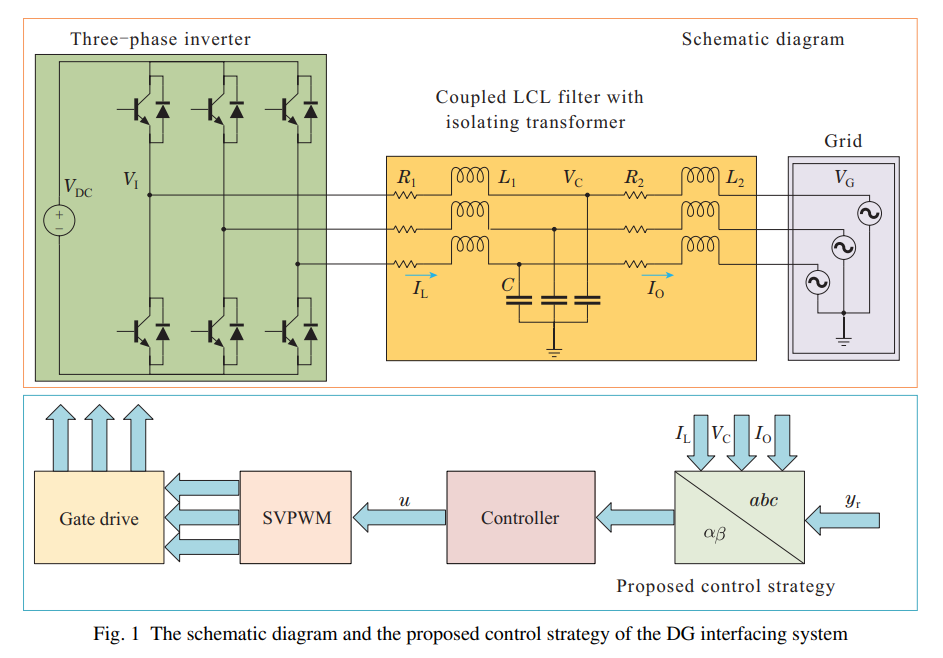
With the rapid development and increasing employment of renewable energy, grid-connected inverters have gained more and more attention because of its reliability and flexibility [1]. As the key components of micro-grids and distributed generation systems, the grid-connected inverters play an important role in providing effective interfaces for renewable and sustainable distributed energy resources.
The grid-connected inverters should operate in a stable way that its output current injecting into the network is as similar as the desired sinusoidal signal, in viewpoint of magnitude, phase and frequency. As such, LCL filters are widely used in grid-connected inverter for its better ability of attenuating the switchingfrequency harmonics [2]. This is important for modern power electronics devices requiring high power quality. However, due to the inherent resonance of LCL filters, the inverter systems are subject to instability problem [3]. Thus, passive damping techniques from the viewpoint of circuit design have been investigated to reduce the undesired resonant oscillation. Different approaches have been proposed such as modifying reactive elements with different topologies [4], using optimization algorithms for filters parameter design [5] and using adaptive observer and event-triggered mechanism for control mechanism [6] and the references therein. As drawbacks, the passive damping methods increase the filter volume and power losses [7].
To avoid the drawbacks, one alternative solution is to employ the active damping techniques, consisting in modifications of the control diagram without extra losses. Various control methods have been routinely used to enhance the performance of grid-connected inverters which, in general, include the popular proportional integral (PI) control [8–9] and proportional resonant (PR) control [10–11]. In [8], based on feedback linearization technique, a PI controller has been designed by combining a disturbance observer. Unfortunately, a main demerit of the feedback linearization technique is that the exact knowledge of model parameters needs to be known. In [9], based on system feedback ratio matrix, a novel perspective of stability analysis has been proposed, which is more suitable for engineering because of its low computational complexity and high accuracy. For the PR controller in stationary reference frame, as stated in [10], it is almost an equivalent alternative to synchronous frame PI controllers. It removes the computational-intensive transformation from stationary frame to synchronous frame [11]. By choosing a infinite gain at the chosen resonant frequency, it can theoretically achieve zero steady-state error.
In order to effectively achieve the current tracking for grid-connected inverters, research effort has been put into developing some other advanced control strategies because of the great computing power available from modern digital signal processors. Model predictive control (MPC) is designed to minimize the tracking error by defining a cost function [12], and therefore, it offers a straightforward way to include required constraints and nonlinearities in the control law. Its applications in the power electronics field can be found in [12–14]. In [13], an observer-based control architecture was proposed to reduce the required sensors, eliminate measurement noise and reduce the influence of grid disturbance and parameter uncertainty. In [14], by using the state estimator, the disturbance observer and the cost function, a sensorless MPC protocol based on the grid-side current measurement was proposed for a gridconnected inverter with LCL filter, which can suppress the filter resonance frequency component and against the variation of grid impedance.
The aforementioned literature for the active damping controller design hardly take into account robustness to external disturbance and parameter uncertainty. Variations of inverter parameters and grid impedance would result in changes of resonance frequency such that the original fixed control gains may fail to give the satisfactory performance. To overcome this challenge, sliding mode control (SMC) has been studied in recent work [15–17]. SMC has the ability to reject parameters deviations and undesirable disturbances. In [17], a finite-time full-order sliding mode method was proposed to enhance the response speed and robustness of the inverter system. In addition to SMC, H∞ control has also been applied to enhance robust performance for its optimal rejection of external disturbances [18–20]. Such a control philosophy usually leads to high controller gains, since it is designed in order to guarantee the satisfactory performance specifications even for the worst-case uncertainties and disturbances. In [18], a linear matrix inequality condition has been proposed to obtain a less conservative controller for the grid-connected inverter. By mixing H2 quality criteria, the study in [19] aims to find a tradeoff between control gain and performance. In [20], by utilizing H∞ observer, a faulttolerant controller was presented to achieve accurate voltage tracking and current sharing for DC microgrids with disturbances.
This article formulates the current tracking control problem of grid-connected inverters under the grid voltage disturbance in the output regulation scheme. The aim of output regulation control (ORC) is to obtain a feedback controller such that the out of a controlled plant can achieve asymptotic tracking with the ability of disturbance rejection, and furthermore, the trajectory of the closed-loop system exists and is bounded [21]. As opposed to the inversion-based tracking control, ORC is designed without requiring differential information knowledge of output tracking error. Hence, ORC provides a more reliable tracking solution since noise in the measured output would not be amplified by differentiation. On the other hand, the tracking performance under the inversion-based scheme is vulnerable to the measurement noise in practice such that the controlled system would even corrupt.
It is worth mentioning that a general framework has been established in [21], where, by using the internal model resulting from an elegant concept of steady-state generator, the output regulation problem can be converted into a stabilization problem. Such a framework lends itself to a greater flexibility of using various stabilization techniques such that the trajectory tracking with external disturbances can be guaranteed under the uncertain parameter [22]. The main contributions are as follows.
1) The paper considers the grid voltage disturbance while designing the current tracking controller for the grid-connected inverters. Moreover, in contrast to the recent work [23–25] using feedback linearization technique and disturbance observer scheme, the output regulation scheme is employed such that the proposed controller allows the parameter uncertainty.
2) The design philosophy gives an explicit step-bystep procedure to determine the controller gains such that, for parameters within any compact subset, the control objective can be achieved. This facilitates the adjustment of controller gains in actual implementations. Steady-state performance with robustness against different parameter settings is remarkable, as verified by simulations.
3) The output regulation framework based on internal model principle proposed in [21] is first applied to grid-connected inverters. Under this framework, the parameter uncertainty and the grid-connected voltage disturbance can be handled and the current asymptotic tracking can be achieved simultaneously.
Conclusions
This article has researched the robust current tracking control problem of the three-phase grid-connected inverters with external sinusoidal disturbances. By the internal model principle, a solution to the problem has been presented by a dynamic state feedback control law. Furthermore, the parameter uncertainty and the grid voltage disturbance have been well handled and the performance recovery has been achieved under the proposed control strategy. In the future, the research will consider an output-based control strategy and extend the results to micro-grid experiment platforms.
作者简介
刘 伟 教授, 博士生导师, 目前研究方向为非线性控制、多智能体系统协同控制、机器人、无人机和电力系统的建模和控制;
吴 本 博士研究生, 目前研究方向为输出调节、非线性控制、事件触发控制、多智能体系统;
孙伟杰 副教授, 目前研究方向为非线性控制、自适应和学习算法、电子设备的控制;
雪 映 教授, 博士生导师, 目前研究方向为含高比例可再生能源电力系统的稳定分析与智能控制、高压直流输电、电力系统电磁暂态仿真以及智能配电网技术;
蔡逢煌 教授, 博士生导师, 目前研究方向为电力电子和控制、故障诊断和嵌入式系统.
期刊介绍
《控制理论与应用》(Control Theory & Applications)是经国家科学技术部批准, 教育部主管, 由华南理工大学和中国科学院数学与系统科学研究院联合主办的全国性一级学术刊物, 1984年创刊, 月刊, 国内外公开发行. 《控制理论与应用》是中国科学引文数据库首批统计源期刊之一,中文核心期刊,入选中国精品科技期刊顶尖学术论文F5000项目,中国科协自动化学科领域高质量科技期刊目录以及中国科协百篇优秀科技论文遴选计划,2021年入选广东省高质量科技期刊建设项目,2022-2024年连续获得基金委资助(科技活动专项)。

【收录】
目前被美国《工程索引》(Ei Compendex)、SCOPUS、CSCD、美国的《化学文摘》(CA)、英国《科学文摘》(Inspec)、德国《数学文摘》、俄罗斯《文摘杂志》(AJ)、《日本科学技术振兴机构中国文献数据库》等国内外检索系统收录。
官网:https://jcta.ijournals.cn/cta_cn/ch/index.aspx
知网优先发表:https://navi.cnki.net/knavi/journals/KZLY/detail
投稿:https://jcta.ijournals.cn/cta_cn/ch/author/login.aspx
微信:控制理论与应用
视频号:控制理论与应用
科学网博客:http://blog.sciencenet.cn/u/CTACTT
小红书:控制理论与应用(ID:8742781006)
Email:aukzllyy@scut.edu.cn
Tel:020-8711 1464

欢迎扫码关注控制理论与应用公众号
【2024-2026年期刊合集】
2025年第42卷第11期(“新一代智能优化理论方法与应用暨纪念郑大钟教授诞辰90周年”专刊)
2024年第41卷第7期(“秦化淑教授90寿诞—复杂系统控制理论及其应用”专刊)
2024年第41卷第6期(“数据与模型融合的智能调度优化”专刊)
2024年第41卷第3期(“人工智能驱动的过程工业自动化与智能化”专刊)
https://blog.sciencenet.cn/blog-3633987-1526095.html
上一篇:《控制理论与应用》2026年第2期虚拟专刊:控制理论
下一篇:【论文推荐】基于Koopman算子的磁流变阻尼器力跟踪控制