博文
2025 年诺贝尔生理学或医学奖得主在 Frontiers in Immunology 发表的研究成果
||
北京时间 2025 年 10 月 6 日,诺贝尔生理学或医学奖,把“外周免疫耐受”带进了大众视野。美国系统生物学研究所 Mary E. Brunkow、索诺玛生物治疗公司的 Fred Ramsdell,以及日本大阪大学的Shimon Sakaguchi,因在“外周免疫耐受”机制方面的突破性发现,共同荣获 2025 年诺贝尔生理学或医学奖。
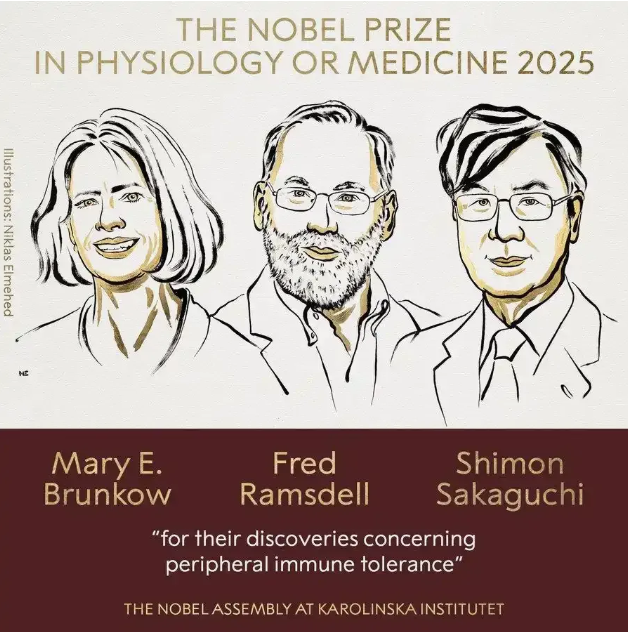
其中,来自日本大阪大学的 Shimon Sakaguchi 教授曾先后于 Frontiers in Immunology (IF:5.9 | CiteScore:10.8) 贡献了多篇重要研究,本合集特此对其成果进行集中展示。
文章
荐读
IF: 5.9 | Cite score: 10.8
胸腺发育过程中调节性T细胞特异性表观遗传印记的动态形成
Dynamic Imprinting of the Treg Cell-Specific Epigenetic Signature in Developing Thymic Regulatory T Cells
Regulatory T (Treg) cells mainly develop within the thymus and arise from CD25+Foxp3− (CD25+ TregP) or CD25−Foxp3+ (Foxp3+ TregP) Treg cell precursors resulting in Treg cells harboring distinct transcriptomic profiles and complementary T cell receptor repertoires. The stable and long-term expression of Foxp3 in Treg cells and their stable suppressive phenotype are controlled by the demethylation of Treg cell-specific epigenetic signature genes including an evolutionarily conserved CpG-rich element within the Foxp3 locus, the Treg-specific demethylated region (TSDR). Here we analyzed the dynamics of the imprinting of the Treg cell-specific epigenetic signature genes in thymic Treg cells. We could demonstrate that CD25+Foxp3+ Treg cells show a progressive demethylation of most signature genes during maturation within the thymus. Interestingly, a partial demethylation of several Treg cell-specific epigenetic signature genes was already observed in Foxp3+ TregP but not in CD25+ TregP. Furthermore, Foxp3+ TregP were very transient in nature and arose at a more mature developmental stage when compared to CD25+ TregP. When the two Treg cell precursors were cultured in presence of IL-2, a factor known to be critical for thymic Treg cell development, we observed a major impact of IL-2 on the demethylation of the TSDR with a more pronounced effect on Foxp3+ TregP. Together, these results suggest that the establishment of the Treg cell-specific hypomethylation pattern is a continuous process throughout thymic Treg cell development and that the two known Treg cell precursors display distinct dynamics for the imprinting of the Treg cell-specific epigenetic signature genes.
原文链接👇
| https://www.frontiersin.org/journals/immunology/articles/10.3389/fimmu.2019.02382/full?utm_source=kexuewang&utm_medium=social&utm_content=noble&utm_campaign=artpromchn |
文章
荐读
IF: 5.9 | Cite score: 10.8
自身免疫性 T 细胞介导的滑膜组织炎症
Synovial Tissue Inflammation Mediated by Autoimmune T Cells
In rheumatoid arthritis (RA), various hematopoietic and non-hematopoietic cells present in the synovial tissue secrete numerous inflammatory mediators including pro-inflammatory cytokines critical for the induction of chronic joint inflammation and bone destruction. Fibroblast-like synoviocytes (FLSs) in the non-hematopoietic cell compartment are key inflammatory cells activated in inflamed joints and driving the disease; yet how synovial tissue inflammation is modulated by autoimmune T cells is not fully understood. In this review, mainly based on recent findings with a mouse model of spontaneous autoimmune arthritis, we discuss the mechanism of Th17-mediated synovial tissue inflammation; that is, what environmental stimuli and arthritogenic self-antigens trigger arthritis, how arthritogenic T cells initiate joint inflammation by stimulating FLSs, and how the cellular sources of GM-CSF from lymphoid and tissue stromal cells in the synovium contribute to the development of arthritis. We also highlight possible plasticity of Th17 cells toward pathogenic GM-CSF producers, and the functional instability of regulatory T cells under inflammatory conditions in RA joints.
原文链接👇
| https://www.frontiersin.org/journals/immunology/articles/10.3389/fimmu.2019.01989/full?utm_source=kexuewang&utm_medium=social&utm_content=noble&utm_campaign=artpromchn |
文章
荐读
IF: 5.9 | Cite score: 10.8
IgM Fc 受体在免疫系统中的功能作用
Functional Roles of the IgM Fc Receptor in the Immune System
It is now evident from studies of mice unable to secrete IgM that both non-immune “natural” and antigen-induced “immune” IgM are important for protection against pathogens and for regulation of immune responses to self-antigens. Since identification of its Fc receptor (FcμR) by a functional cloning strategy in 2009, the roles of FcμR in these IgM effector functions have begun to be explored. Unlike Fc receptors for switched Ig isotypes (e.g., FcγRs, FcεRs, FcαR, Fcα/μR, pIgR, FcRn), FcμR is selectively expressed by lymphocytes: B, T, and NK cells in humans and only B cells in mice. FcμR may have dual signaling ability: one through a potential as yet unidentified adaptor protein non-covalently associating with the FcμR ligand-binding chain via a His in transmembrane segment and the other through its own Tyr and Ser residues in the cytoplasmic tail. FcμR binds pentameric and hexameric IgM with a high avidity of ~10 nM in solution, but more efficiently binds IgM when it is attached to a membrane component via its Fab region on the same cell surface (cis engagement). Four different laboratories have generated Fcmr-ablated mice and eight different groups of investigators have examined the resultant phenotypes. There have been some clear discrepancies reported that appear to be due to factors including differences in the exons of Fcmr that were targeted to generate the knockouts. One common feature among these different mutant mice, however, is their propensity to produce autoantibodies of both IgM and IgG isotypes. In this review, we briefly describe recent findings concerning the functions of FcμR in both mice and humans and propose a model for how FcμR plays a regulatory role in B cell tolerance.
原文链接👇
| https://www.frontiersin.org/journals/immunology/articles/10.3389/fimmu.2019.00945/full?utm_source=kexuewang&utm_medium=social&utm_content=noble&utm_campaign=artpromchn |
文章
荐读
IF: 5.9 | Cite score: 10.8
滤泡调节性T细胞在生发中心反应调控中的作用机制
Control of Germinal Center Responses by T-Follicular Regulatory Cells
Regulatory T-cells (Treg cells), expressing the transcription factor Foxp3, have an essential role in the control of immune homeostasis. In order to control diverse types of immune responses Treg cells must themselves show functional heterogeneity to control different types of immune responses. Recent advances have made it clear that Treg cells are able to mirror the homing capabilities of known T-helper subtypes such as Th1, Th2, Th17, and T-follicular helper cells (Tfh), allowing them to travel to the sites of inflammation and deliver suppression in situ. One of the more recent discoveries in this category is the description of T-follicular regulatory (Tfr) cells, a specialized subset of Treg cells that control Tfh and resulting antibody responses. In this review we will discuss recent advances in our understanding of Tfr biology and the role of both Tfr and activated extra-follicular Tregs (eTreg) in the control of humoral immunity.
原文链接👇
| https://www.frontiersin.org/journals/immunology/articles/10.3389/fimmu.2018.01910/full?utm_source=kexuewang&utm_medium=social&utm_content=noble&utm_campaign=artpromchn |
文章
荐读
IF: 5.9 | Cite score: 10.8
调节性 T 细胞最小信息标准:推动研究可重复性与标准化建设
Minimum Information about T Regulatory Cells: A Step toward Reproducibility and Standardization
Cellular therapies with CD4+ T regulatory cells (Tregs) hold promise of efficacious treatment for the variety of autoimmune and allergic diseases as well as posttransplant complications. Nevertheless, current manufacturing of Tregs as a cellular medicinal product varies between different laboratories, which in turn hampers precise comparisons of the results between the studies performed. While the number of clinical trials testing Tregs is already substantial, it seems to be crucial to provide some standardized characteristics of Treg products in order to minimize the problem. We have previously developed reporting guidelines called minimum information about tolerogenic antigen-presenting cells, which allows the comparison between different preparations of tolerance-inducing antigen-presenting cells. Having this experience, here we describe another minimum information about Tregs (MITREG). It is important to note that MITREG does not dictate how investigators should generate or characterize Tregs, but it does require investigators to report their Treg data in a consistent and transparent manner. We hope this will, therefore, be a useful tool facilitating standardized reporting on the manufacturing of Tregs, either for research purposes or for clinical application. This way MITREG might also be an important step toward more standardized and reproducible testing of the Tregs preparations in clinical applications.
原文链接👇
| https://www.frontiersin.org/journals/immunology/articles/10.3389/fimmu.2017.01844/full?utm_source=kexuewang&utm_medium=social&utm_content=noble&utm_campaign=artpromchn |
文章
荐读
IF: 5.9 | Cite score: 10.8
调节性 T 细胞发育的分子决定因素:表观遗传变化的核心作用
Molecular determinants of regulatory T cell development: the essential roles of epigenetic changes
Regulatory T (Treg) cells constitute a distinct T cell subset, which plays a key role in immune tolerance and homeostasis. The transcription factor Foxp3 controls a substantial part of Treg cell development and function. Yet its expression alone is insufficient for conferring developmental and functional characteristics of Treg cells. There is accumulating evidence that concurrent induction of Treg-specific epigenetic changes and Foxp3 expression is crucial for lineage specification and functional stability of Treg cells. This review discusses recent progress in our understanding of molecular features of Treg cells, in particular, the molecular basis of how a population of developing T cells is driven to the Treg cell lineage and how its function is stably maintained.
原文链接👇
| https://www.frontiersin.org/journals/immunology/articles/10.3389/fimmu.2013.00106/full?utm_source=kexuewang&utm_medium=social&utm_content=noble&utm_campaign=artpromchn |
文章
荐读
IF: 5.9 | Cite score: 10.8
多重调节性 T 细胞抑制模块及其适应性调控机制
Multiple Treg suppressive modules and their adaptability
Foxp3+ regulatory T cells (Tregs) are a constitutively immunosuppressive cell type critical for the control of autoimmunity and inflammatory pathology. A range of mechanisms of Treg suppression have been identified and it has not always been clear how these different mechanisms interact in order to properly suppress autoimmunity and excessive inflammation. In recent years it has become clear that, while all Tregs seem to share some core suppressive mechanisms, they are also able to adapt to their surroundings in response to a variety of stimuli by homing to the sites of inflammation and exerting ancillary suppressive functions. In this review, we discuss the relevance and possible modes of Treg adaptability and put forward a modular model of Treg suppressive function. Understanding this flexibility may hold the key to understanding the full spectrum of Treg suppressive behavior.
原文链接👇
| https://www.frontiersin.org/journals/immunology/articles/10.3389/fimmu.2012.00178/full?utm_source=kexuewang&utm_medium=social&utm_content=noble&utm_campaign=artpromchn |
Frontiers in Immunology 是瑞士出版社 Frontiers 旗下的开放获取期刊,是一本多学科交叉期刊,发表涵盖基础、转化与临床免疫学领域的研究。期刊重点展示在动物与细胞模型以及人体研究中,对免疫性疾病诊断与治疗的前沿进展和新颖方法。该刊位于 JCR Q1 区,已被 MEDLINE、PubMed Central、Scopus、SCIE 等核心数据库收录,并且是国际免疫学联合会(IUIS)的官方期刊。
https://blog.sciencenet.cn/blog-3465500-1507864.html
上一篇:Frontiers 与国家科技图书文献中心(NSTL) 联合举办开放获取合作期刊投稿培训会
下一篇:第三届中瑞科研诚信研讨会召开 —— 聚焦可信赖科研生态建设