博文
[转载]Innovation Focus in 2025 | The Innovation
||
导 语
From fundamental innovations in large scientific facilities to united scientific warnings on climate thresholds, from circular solutions like biomass carbon sinks to foundational advances in functional materials and rare earths, from enabling hardware in integrated circuits to the convergent integration of AI with biological health and robotics, and onward to transformative applications in personalized medicine and smart agriculture...... The Innovation’s editorial team presents a review of the major scientific breakthroughs in 2025 (Figure 1).
2025年科技创新的焦点有哪些?
从大型科学设施的基础性创新,到针对气候温度阈值的联合科学预警;从生物质碳汇等循环解决方案,到功能材料与稀土元素的基础性突破;从集成电路等关键赋能硬件,到人工智能与生物健康及机器人技术的融合集成,进而推动个性化医疗与智慧农业的变革性应用……《创新》编辑团队梳理了2025年的科学突破。

1 智慧农业:塑造农业科研新范式
Agricultural research is undergoing a profound paradigm shift, driven by smart agriculture. The development of an agricultural "digital brain" enables precise, full-chain monitoring and intelligent decision-making, laying a resilient foundation for future food systems. As a core engine of smart agriculture, intelligent breeding is propelling the agricultural 'chip'-seeds-into a new era. Breakthroughs and refinements in synthetic apomixis allow for the permanent fixation of superior hybrid vigor, fundamentally transforming seed production models. Technologies like polyploid breeding unlock new frontiers in crop genome design and de novo domestication, significantly accelerating precision breeding processes. Scientists pioneered the "crop-robot co-design" strategy, which deeply integrates biotechnology with information technology, giving rise to "robot-friendly" male-sterile exserted-stigma lines. The creation of the first intelligent breeding robot "GEAIR" (genome editing with artificial-intelligence-based robots), overcomes the efficiency and accuracy limitations of traditional manual pollination, leading the global breeding industry into an intelligent acceleration era. Looking ahead, smart agriculture will continue to reshape the mindset and methodological frameworks of agricultural research, steering the sector towards greater intelligence, sustainability, and eco-friendliness.
农业科研正经历由智慧农业驱动的深刻范式变革:农业“数字大脑”的构建,实现了全链条精准感知与智能决策,奠定了未来粮食系统的韧性根基;智能育种作为智慧农业的核心引擎,正加速农业‘芯片’迈向全新阶段:人工无融合生殖技术的突破与优化,可实现杂交优良性状的永久固定,彻底变革种子生产模式;多倍体育种等技术打开了作物基因组设计与从头驯化的全新空间,显著加速精准设计育种进程;“作物-机器人协同设计”理念深度融合生物技术与信息技术,催生“机器人友好型”不育系,首台智能育种机器人“吉儿”的诞生,彻底突破传统人工授粉的效率与精度瓶颈,引领全球育种行业迈入智能加速时代......未来,智慧农业将持续重塑农业科研的思维与方法体系,推动农业向智慧化、绿色化与可持续化方向不断迈进。
2 升温破线警示:团结在科学之中
The 1.5°C warming target of the Paris Agreement is facing severe challenges. Multiple international institutions have confirmed that 2024 marked the first year when global average temperature rise exceeded 1.5°C relative to pre-industrial levels, and the past three years have been the warmest three on record. Although global warming eased to 1.42°C ± 0.12°C in January-August 2025 (per the World Meteorological Organization's latest report), the single-year breach has sent a strong signal, highlighting the urgency of globally coordinated climate action. Regrettably, the United States withdrew from the Paris Agreement once again in 2025, adding uncertainty to the multilateral climate governance system and making the implementation of countries' third round of Nationally Determined Contributions more challenging. As the "outposts" of climate change, the "Three Poles of the Earth"—the Arctic, Antarctic, and Qinghai-Xizang Plateau—profoundly influence the global climate through atmospheric and oceanic connections. Meanwhile, technological means such as precise prediction based on complex climate networks are becoming crucial for addressing extreme weather. The World Meteorological Organization has put forward the global slogan "United in Science." Empowering low-carbon transitions and ecological protection through science and technology is an essential imperative for global climate adaptation and mitigation efforts.
《巴黎协定》的1.5°C控制目标正遭受严峻挑战。多家国际机构已确认,2024年是全球首次出现相较工业化前水平升温超1.5°C的年度,近三年更是有记录以来最暖的三年。尽管世界气象组织最新报告显示2025年1-8月全球升温回调至 1.42°C±0.12°C,但单年“破界”已释放强烈信号,凸显全球协同的气候行动的紧迫性。令人遗憾的是,美国2025年再次退出《巴黎协定》,不仅给气候治理多边合作增添不确定性,也使各国第三轮国家自主贡献的落实更具挑战。作为气候变化“前哨”,由北极、南极、青藏高原构成的“地球三极”深刻影响全球气候,基于气候复杂网络的精准预测等预警技术,正成为应对极端天气的关键工具。世界气象组织提出全球口号“团结在科学之中”,以科技赋能低碳转型与生态保护,是全球气候适应与减缓行动的必修课。
3 变“废”为“汇”:木质纤维素基碳汇新材料推动循环经济发展
Driven by global commitments to "carbon peaking and carbon neutrality" and the "plastic restriction" targets, the development of carbon-sink materials derived from lignocellulosic biomass has become an increasingly important direction for synergistic innovation in "carbon mitigation-pollution reduction." Constructing low-carbon or carbon-negative materials from non-grain biomass can reduce dependence on fossil resources and alleviate plastic pollution, while also converting the carbon stored in agricultural and forestry residues into safe, biodegradable bioproducts. This enables long-term sequestration of biogenic carbon and value-added utilization of low-value biomass. Recent technological advances highlight the breadth of this potential. Microwave-assisted rapid hybridizing, for example, can rapidly convert used everyday paper and CO2 into high-performance paper plastics, offering a practical strategy for "paper substitution for plastics." Another exciting progress is the direct conversion of woody biomass into a carbon-negative structural material—bio-strong-wood, through a green and efficient bio-assisted cell-wall engineering strategy. This strategy, for the first time, realizes zero-waste-discharge processing of woody biomass and net-negative carbon emissions across the entire life cycle. Together, these emerging biomass-based carbon-sink materials mark a shift in the materials field—from traditional carbon-emission-reduction approaches toward genuinely negative-carbon solutions. Their continued development will play a pivotal role in advancing the circular economy and supporting global sustainability goals.
在全球积极推进“双碳”和“禁塑”战略背景下,发展木质纤维素基碳汇新材料已成为“降碳-减污”协同创新的重要方向。以非粮生物质为主要原料构筑低碳或负碳材料,不仅可减少对化石资源的依赖、缓解白色污染,还可将农林固废内的碳源转化为安全可降解的绿色新材料,实现生物碳的持久封存与低值生物质的高值转化。近来,研究人员通过微波辅助成型技术实现了高性能纸塑料的快速制备,为“以纸代塑”提供了可行方案。同时,生物辅助细胞壁工程策略的提出,使木材能以高效、低碳方式转化为生物强化木材,首次实现了木材加工的零废弃物排放及全生命周期负碳排放。这些生物质基碳汇新材料为材料研发从“高碳排放”向“低碳排放”乃至“负碳排放”的范式转变提供了支撑,同时也为循环经济与可持续发展奠定了重要基础。
4 生物健康:新技术涌现与AI融合
In 2025, the emergence of new methods and technologies is driving biological research to take root in health-oriented applications. Antimicrobial resistance poses a major global public health challenge. Researchers have established a new paradigm linking geometry, mechanics, and infection, offering a fresh perspective for targeting the physical microenvironment in anti-infective strategies. Meanwhile, organoid technology is providing highly biomimetic, human-relevant models for biological research. A recently developed single-chain-activating antibody overcomes a core bottleneck in organoid culture, paving the way for standardized production and clinical-grade applications. With the development of OvaRePred—the world’s first individualized prediction model for ovarian function decline—artificial intelligence is accelerating the transformation of both fundamental and applied research paradigms in life and health sciences. Virtual cells, built on massive single-cell omics datasets and large AI models, create digital twin systems that can accurately predict the dynamic responses of real cells. In the future, integrated models that combine novel molecular-interference methods, AI vertical foundation models, biomedical imaging, and large-scale omics data will systematically dissect key disease determinants and functional mechanisms, propelling biology into a new era that is predictable, simulable, and engineerable.
2025年,新方法新技术涌现推动生物学研究向健康应用端扎根式发展。针对耐药菌这一全球公共健康的重大挑战,研究者建立“几何-力学-感染”新范式,为靶向物理微环境的抗感染提供全新视角。另外,类器官技术为生物研究提供高度仿生的人源化模型。研究者开发的单链激活抗体突破了类器官培养核心瓶颈,为其标准化制备及临床级应用铺平道路。伴随全球首个卵巢功能衰退个体化预测模型OvaRePred的研发,人工智能正加快重塑生命健康基础与应用研究范式。虚拟细胞依托海量单细胞组学数据和AI大模型构建数字孪生系统,可精确预测真实细胞动态响应。未来,结合分子干扰新方法、AI垂直大模型、生物医学图像与组学大数据构建的融合模型,将系统解析疾病关键影响因素与功能机制,驱动生物学迈向可预测、可模拟、可工程化的新时代。
5 集成电路-MZT新结构带来面积与功能集成度提升
Dimensional scaling driven by Moore's Law is approaching a bottleneck, prompting a paradigm shift in integrated circuit development toward functional integration. In the field of devices, a multifunctional multi-terminal zero-additional-resistor-process one-transistor with the novel channel electrode design architecture (MZT) has emerged as a transformative technology. It not only integrates sensing, memory, and logic functionalities into a single unit, but also maintains compatibility with silicon-based production lines, thereby laying a foundation for the industrialization of in-memory computing (IMC) chips. In addition to traditional computing-in-memory (CIM) devices that solely give current outputs for analog storage, MZT enables voltage outputs for digital computation—endowing it with the capabilities to realize integrated "perception-analog storage-digital computation" comparable to those of the human brain. In power-sensitive scenarios such as visual AI, MZT-based ICM chips and CIM chips demonstrate significant advantages. The brain-inspired chip Speck™, built on conventional CIM devices, has already established a commercial benchmark. Utilizing a spiking convolutional neural network architecture, this chip achieves milliwatt-level low-power operation. Furthermore, the thin-film transistor (TFT) processing technology is compatible with MZT. DNA microarray synthesizers developed based on the mature TFT processing technology have drastically reduced the cost of DNA synthesis, injecting new momentum into the advancement of life sciences. Breakthroughs in functionality and area integration enabled by novel structures exemplified by MZT are spearheading a new revolution in semiconductor technology, driving innovations across diverse scientific disciplines.
随着摩尔定律驱动的尺寸微缩接近瓶颈,集成电路发展或转向功能集成,器件领域提出多功能多端无外加电阻工艺的新沟道设计架构单晶体管(MZT),该结构不但可将传感、存储、逻辑计算集成一体,还兼容现有硅生产线,为存算芯片产业化提供基础。与传统存算器件仅能输出电流进行模拟存储不同,MZT还能输出电压进行数字计算,具备实现堪比人脑的“感知-模拟存-数字算”一体化能力。存算架构在视觉AI等功耗敏感场景中,优势明显,其类脑芯片Speck™采用脉冲卷积神经网络架构,实现毫瓦级低功耗运行,已完成商业化示范。同时,薄膜晶体管(TFT)工艺兼容MZT。TFT工艺应用于DNA微阵列合成仪,显著降低其合成成本,为生命科学发展注入新动力。以MZT为代表的新器件结构,正引领半导体技术新革新,推动多学科协调发展。
6 机器人:物理智能与具身认知的协同进化
Robotics is now embracing the transformative shift toward "embodied intelligence," moving beyond the stereotype of "pre-programmed automation" to demonstrate a synergistic evolution of physical and cognitive intelligence, advancing toward general-purpose agents capable of both environmental adaptation and cognitive generalization. At the physical level, environmental coexistence biomimetic millirobots have established a new paradigm of "endogenous physical intelligence". By leveraging smart materials that respond directly to environmental stimuli, these robots acquire an innate "sensing–deformation–adaptation" capability, transitioning from passive intervention to active adaptation. This enables them to operate efficiently in complex biological or precision environments with an "environmental coexistence" approach. At the cognitive level, Embodied Foundation Models embrace a scalable engineering paradigm driven by data. It leverages large-scale real-world operational data to construct universal robotic learning platforms, and adopts the concept of a "latent action space" as a generalized interface. This interface seamlessly bridges multimodal inputs with action outputs, endowing robotic systems with generalization capabilities rooted in "learning by analogy" and thereby reducing the technical threshold for development. From the awakening of "physical instinct" to the reconfiguration of "cognitive generalization," robotics is accelerating its integration into human society through the deep coupling of physical entities and digital intelligence.
机器人技术聚焦“具身智能”变革,突破传统“预编程自动化”局限,呈现物理与认知智能的协同演进,向具备环境自适应与认知泛化的通用智能体迈进。在物理层面,环境共融仿生微机器人提出“内源性物理智能”新范式。依托智能材料对环境的直接响应,机器人具备“感知-形变-适应”本能,实现从被动执行到主动适应转变,在复杂生物或精密场景中高效作业。在认知层面,具身基础模型正在确立“通用决策”新高地。以数据驱动构建规模化工程路径,通过“视觉-语言-动作”的跨模态联合表征,机器人具备开放环境下的语义理解与常识推理能力,打通了从高层抽象意图到底层物理控制的转化链路,标志着机器人从单一技能复刻迈向了通用智能决策的新阶段。从“物理本能”觉醒到“认知泛化”重构,机器人技术正通过实体形态与数字智能的深度耦合,加速融入人类社会。
7 新功能金属有机框架材料(MOF)
The precise construction of molecular structure is the key to developing new functional materials and pushing the boundaries of performance of materials. In 2025, Susumu Kitagawa, Richard Robson, and Omar M. Yaghi were awarded the Nobel Prize in Chemistry for their pioneering work in the synthesis of metal–organic framework (MOF) materials, and for establishing a new paradigm for precise construction of MOF structure. This year, the ability in sophisticated design and regulation of MOF materials have reached new heights. Researchers have proposed an innovative "supramolecular docking MOF structure" strategy, which addresses the long-standing challenge of determining the structure of alkyl chain-containing molecules and offering an efficient structural analysis tool for fields such as natural product research, drug development, and organic synthesis. Moreover, the concept of "synergistic transport of energy carriers" has been introduced for designing MOF porous structure, breaking through the performance limits of MOF materials and advancing their applications in the energy sector. Furthermore, a "multi-scale structural disorder" strategy has been employed to endow MOFs with intrinsic weak ferromagnetism at room temperature for the first time, opening new avenues for developing next-generation multifunctional materials. These molecular construction strategies are driving MOFs to achieve a leap from structural precision control to performance enhancement, bringing revolutionary advances to their applications in emerging fields such as energy storage and sensing.
分子结构的精准构建是开发新功能材料和突破性能极限的关键。2025年,因率先制备和发展金属有机框架(MOF)材料,并开创其精准构筑新范式,Susumu Kitagawa、Richard Robson和Omar M. Yaghi获诺贝尔化学奖。同年,该领域结构设计与调控能力正持续攀升:科学家提出“超分子对接MOF结构”策略,解决了含烷基链分子结构测定难题,为天然产物、药物研发和有机合成等领域提供了高效解析工具;提出“能量载体协同传输”多孔结构设计思路,突破多孔材料在能量储存与转化中的性能极限;采用“多尺度结构无序化”策略,首次使MOF具备室温本征弱铁磁性,为多功能材料开辟新方向。这些分子构筑方法,正驱动MOF实现从结构精控到性能跃迁,为能源、传感等新领域的应用带来革命性进展。
8 精准调控,生命科学迈向个性化医疗新纪元
Life science is undergoing a paradigm shift from observation and description to precise design and intervention: the DNA-writing-based programmable artificial transcription factor library (DIAL technology) achieves fine-tuned gene expression by programming the spatial structure of promoters; targeting "migrasomes" has successfully delayed brain aging; the "thromboinflammation-on-a-chip" has for the first time enabled the observation of the entire process of microvascular thrombus formation and dissolution, revealing the dual role of neutrophil elastase and validating the therapeutic window for thrombolytic drugs... These breakthroughs signify that life science has developed a comprehensive novel capability for precise regulation—from cutting-edge gene regulation, to the intervention of intercellular communication, and further to the precise simulation of pathological processes. This is not merely an upgrade of technological tools; more importantly, it heralds a new, personalized era in the medical paradigm, shifting from "treating the symptoms" to "tailoring therapies to the individual." Looking ahead, as our ability to master biological processes at the molecular, cellular, and systems levels continues to improve, personalized medicine is accelerating its transition from a scientific vision into clinical reality.
生命科学正经历从观察描述到精准设计与干预的范式跃迁:DNA集成人工库(DIAL技术)通过编程启动子空间结构实现基因表达的精细调控;靶向“迁移体”成功延缓脑衰老进程;“血栓炎症芯片”首次实现微血管血栓形成与溶解的全过程观测,揭示了中性粒细胞弹性蛋白酶的双刃剑作用,验证了溶栓药物的治疗窗口......这些突破标志着生命科学已形成全新的精准调控能力——从前沿基因调控,到细胞间通讯干预,再到病理过程精确观测。这不仅是技术工具的升级,更意味着医疗范式将从“对症下药”转向“因人施策”的个性化新时代。面向未来,随着我们在分子、细胞和系统层面对生命过程的掌控能力的持续提升,个性化医疗正从科学愿景加速迈向临床现实。
9 大科学装置:基础研究原始创新的关键支撑和重要引擎
A number of large scientific facilities have been completed and are operating efficiently as scheduled in 2025, yielding a series of key breakthroughs. In January, Experimental Advanced Superconducting Tokamak achieved a steady-state high-confinement plasma for a remarkable 1066 seconds at a temperature of 100 million ℃, marking a new stage for China’s research on controlled nuclear fusion. From June to July, the Five-hundred-meter Aperture Spherical Radio Telescope published new findings on the physical nature of black holes and observed a complex filamentary structure network dominated by supersonic turbulence within an interstellar gas cloud moving at ultrahigh speed in the Milky Way. In October, the High Energy Photon Source project passed process acceptance, while the High Intensity Heavy-ion Accelerator Facility successfully completed beam commissioning. In November, the Large High Altitude Air Shower Observatory made big progress in revealing a key mechanism of cosmic ray origin and opening new pathways for understanding the extreme physical processes of black hole systems. Also in November, the Jiangmen Underground Neutrino Experiment precisely measured the solar neutrino oscillation parameters. In addition, the international science program for "Burning Plasma" of the Chinese Academy of Sciences was officially launched, and the research plan for the Burning Plasma Experimental Superconducting Tokamak, a compact fusion experiment device, was released. Large Scientific Facilities have become the cornerstone and engine of basic research innovation, enabling humanity to deepen its understanding of the origins of the universe, the composition of matter, and explore new pathways for sustainable energy development.
一批大科学装置于2025年陆续建成并高效运行,取得重要成果。1月,全超导托卡马克核聚变装置实现上亿度、1066秒稳态长脉冲高约束模等离子体运行,标志我国在可控核聚变研究迈入新阶段。6至7月,500米口径球面射电望远镜在黑洞物理及银河系超高速星际气体云研究方面取得新突破。10月,高能同步辐射光源项目完成工艺验收;强流重离子加速器调试成功并实现束流贯通。11月,高海拔宇宙线观测站在揭示宇宙线起源关键机制和极端黑洞物理方面取得进展;江门中微子实验精确测量太阳中微子振荡参数。同时,中国科学院燃烧等离子体国际科学计划项目启动,面向紧凑型核聚变研究布局未来。这些大科学装置正成为基础研究原始创新的重要引擎,支撑人类探索宇宙起源、认知物质本质,并开辟能源可持续发展新途径。
10 从资源优势到创新引领:稀土科技的战略重塑
Rare earth elements are often called the "vitamins" of modern industry. Beyond this, they are essential for carbon neutrality and advanced manufacturing. Today, the focus of rare earth science is shifting from simple resource extraction to sophisticated technological innovation. The research paradigm is moving from empirical trial-and-error to rational design. The key is to maximize value through precise atomic-scale regulation. In the new energy sector, permanent magnets—enhanced by grain boundary diffusion and microstructure optimization—are forging stronger "hearts" for wind turbines and electric vehicles. Similarly, new catalyst designs based on "electronic-structural-dynamic" mechanisms have broken the activity limits of single atoms, serving as "green engines" for carbon neutrality and hydrogen energy strategies. Crucially, rare earth materials are shattering performance bottlenecks for critical national infrastructure. Advances in nanoscale polishing slurries, ultra-fast scintillation crystals, and heat-resistant alloys have ensured that integrated circuits, medical imaging devices, and aerospace components perform reliably even under extreme conditions. This progress marks a complete chain from basic research to practical application. Looking ahead, the integration of AI-driven research and green extraction will further support a modern, sustainable industrial system.
稀土不仅是现代工业的“维生素”,更是支撑“双碳”与高端制造的战略基石。当前,稀土科技正从“经验试错”迈向“理性设计”,依托原子尺度精准调控重塑材料性能。在新能源领域,永磁材料经晶界扩散与微结构优化,为风电、车辆等装备打造更强劲的动力“心脏” ;催化材料则基于“电子-结构-动态”新机理,突破单原子活性极限,成为碳中和与氢能战略的绿色引擎。面向大国重器的极端服役环境,从集成电路的纳米级抛光液到医学成像超快闪烁晶体、航空航天高温合金,稀土材料不断打破性能瓶颈,实现核心部件在复杂工况中的跃升。这一系列成果表明,从基础到应用的完整创新链已基本形成。未来,稀土科技将加速AI驱动的材料研发与绿色提取融合,为现代化产业体系提供关键支撑。
本文内容来自Cell Press合作期刊The Innovation第7卷以Editorial发表的“Innovation Focus in 2025” (投稿: 2025-12-03;接收: 2025-12-06;在线刊出: 2025-12-09)。
DOI:10.1016/j.xinn.2025.101223
原文链接:https://www.sciencedirect.com/science/article/pii/S2666675825004266
引用格式:The Innovation Editorial Team. (2026). Innovation Focus in 2025. The Innovation 7:101223.


往期推荐
Innovation Focus in 2024 |
Innovation Focus in 2023 |
Innovation Focus in 2022 |
科学网—[转载]《创新肿瘤学》即将创刊 | The Innovation Oncology is coming
科学网—[转载]机器学习在大型科学装置中的应用 | The Innovation Informatics
科学网—[转载]首创临床应用高剂量gp96治疗渐冻症显奇效 | The Innovation Medicine
科学网—[转载]20251016期刊workshop(深圳站)| The Innovation
科学网—[转载]糖尿病防控路在何方?看中国的实践与启示 | The Innovation
科学网—[转载]儿童磁悬浮心室辅助装置D-miniCor 临床应用 | The Innovation
科学网—[转载]“行驶的应急电源”:如何用电动汽车破解极端天气下的城市断电难题?| The Innovation Energy
科学网—[转载]AI解锁中药新纪元:全球首个亿量级草药基因编码天然多样性成分库GNDC问世 | The Innovation
科学网—[转载]干细胞人造胰岛实现83%胰岛素独立:1型糖尿病治疗的新希望与临床转化挑战 | Innovation Medicine
科学网—[转载]《创新信息学》即将创刊 | The Innovation Informatics is coming
科学网—[转载]空天过渡区,神秘太空的探索—物理、化学过程和数值模拟 | The Innovation
科学网—[转载]打通天然矿物空气碳捕集的“任督二脉” | The Innovation Materials
科学网—[转载]木质素缩合新机制助力多样生物基双酚化合物合成 | The Innovation
科学网—[转载]医学人工智能2025:探索无尽的前沿 | The Innovation Medicine
科学网—[转载]DeepSeek:成本革命让大模型不再是少数人的游戏 | The Innovation
科学网—[转载]“拉索”利用宇宙线每日诊脉日地空间磁场 | The Innovation
科学网—[转载]危化品 or 能源,氢能监管走向何方 | The Innovation Energy
科学网—[转载]月球大量开采水的新方法 | The Innovation
科学网—[转载]The Innovation | 2023 Impact Factor = 33.2
The Innovation 简介
扫二维码 | 关注期刊官微
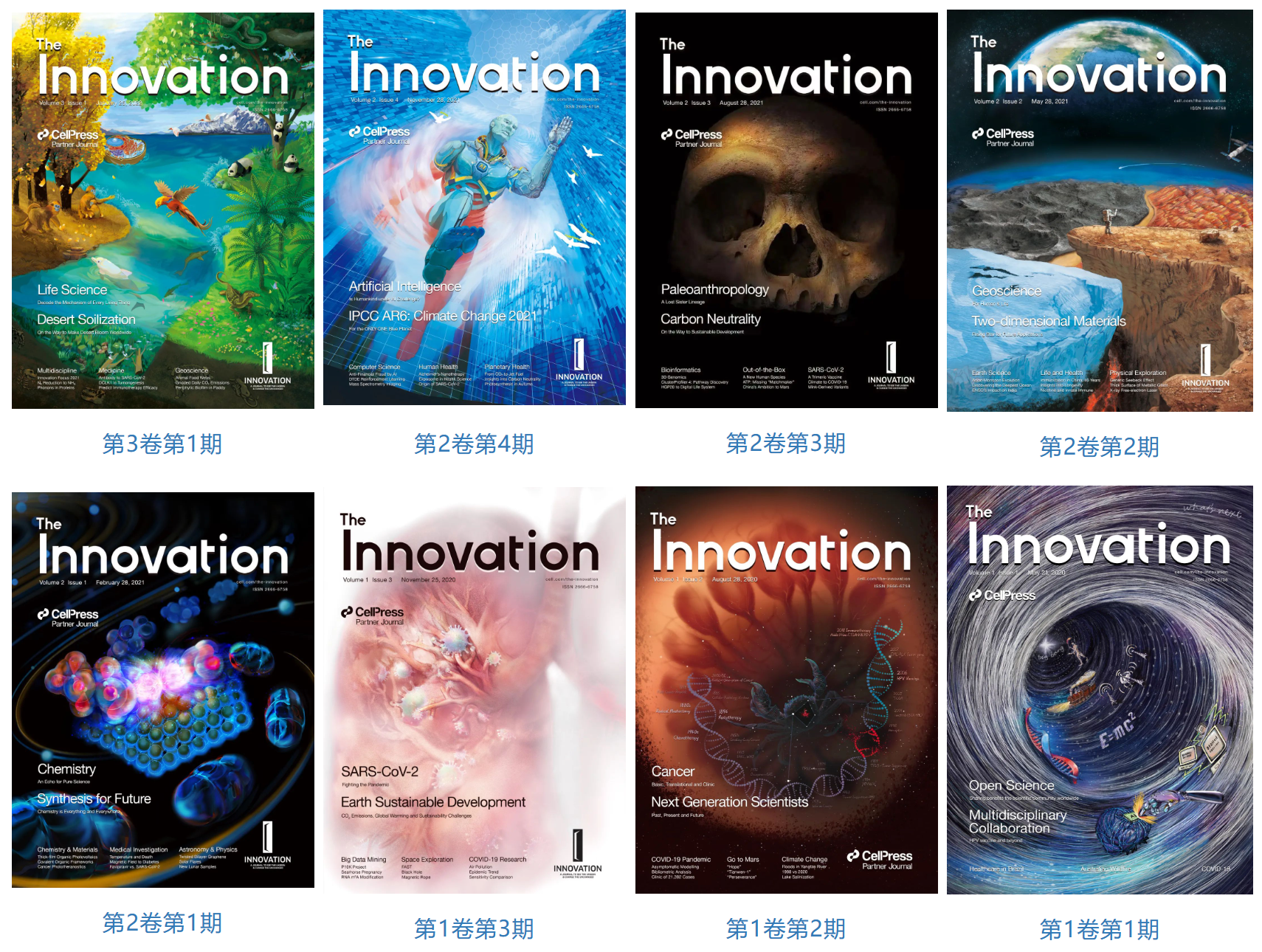
The Innovation是一本由青年科学家与Cell Press于2020年共同创办的综合性英文学术期刊:向科学界展示鼓舞人心的跨学科发现,鼓励研究人员专注于科学的本质和自由探索的初心。作者来自全球61个国家;已被164个国家作者引用;每期1/5-1/3通讯作者来自海外。目前有200位编委会成员,来自22个国家;50%编委来自海外(含39位各国院士);领域覆盖全部自然科学。The Innovation已被DOAJ,ADS,Scopus,PubMed,ESCI,INSPEC,EI,中国科学院分区表(1区TOP)等收录。2024年CiteScore为53.4;2024年影响因子为25.7(5 year lmpact Factor=40.2)。2023年6月25-28日,四本姊妹刊(The Innovation Life、The Innovation Geoscience、The Innovation Materials、The Innovation Medicine)联袂创刊;2024年2月26日,第五本姊妹刊The Innovation Energy出版创刊号。这五本姊妹刊已被Google Scholar, CAS, Scopus等数据库收录。2025年11月10日,第六本姊妹刊The Innovation Informatics出版创刊号。秉承“好文章,多宣传”理念,The Innovation刊群在海内外各平台推广作者文章。
期刊官网:
期刊投稿(Submission):
www.editorialmanager.com/the-innovation
商务合作(Marketing):
marketing@the-innovation.org
The Innovation 姊妹刊


The Innovation



期刊标识
See the unseen & change the unchanged
创新是一扇门,我们探索未知;
创新是一道光,我们脑洞大开;
创新是一本书,我们期待惊喜;
创新是一个“1”,我们一路同行。
https://blog.sciencenet.cn/blog-2497842-1515252.html
上一篇:[转载]储能新方式:氢负离子电池“小荷”已露“尖尖角” | The Innovation Materials
下一篇:[转载]Live: 2025跨年夜科学沙龙--科学造福人类,创新成就未来 | The Innovation